

Your player-coach is drowning
Why cutting layers without fixing fundamentals just creates a different kind of broken

Like Work Forward? Please like ❤️, subscribe 📨, and (most of all) share 🔄

The “player-coach” your CEO just announced has 15 direct reports. Maybe more after the next round of cuts.
Those 15 people are working on somewhere between four and 24 projects. She inherited the previous manager’s worst performer, who’s been on a PIP for two quarters. She has three stars who need real opportunities or they’ll leave. She has direct reports with conflicts inside their projects (the designer just sucks, says one) and conflicts across them (which milestone matters more, who owns what). She has people who want feedback, mastery, purpose. She’s also a human, with a sick kid and a parent in early-stage dementia. And she has back-to-back meetings until 6:30 because her culture rewards facetime.
That’s before we get to the AI Agents she’s overseeing, which are piling brain fry on top of her burnout, increasing the odds of major errors by 39% and her desire to quit by an equal amount. Treating AI Agents as humans only compounds those issues.
Pretending she wasn’t already a ‘player-coach’ is also nuts. Frontline managers have carried their own IC load for decades. What’s new isn’t the model. It’s the pile-on: more direct reports, more projects, more AI oversight, less room to push back. Calling her a ‘player-coach’ now is cover for cutting the support she needed.
She’s not going to tell you that. The job market is grim, and your insistence on going “hardcore” makes complaining a route to the layoff list. So she keeps her head down. The bad news for you: the good ones have options. You didn’t lay off the people fighting against AI. You kept your best AI talent. You know, the marketable ones.
This is the reality behind the latest tech management craze. It’s not new, and it isn’t really about AI. It’s tech CEOs like Coinbase’s Brian Armstrong following Block CEO Jack Dorsey’s manifesto, cutting layers, eliminating managers, and positioning AI to handle the coordination work. Treating managers as routers.
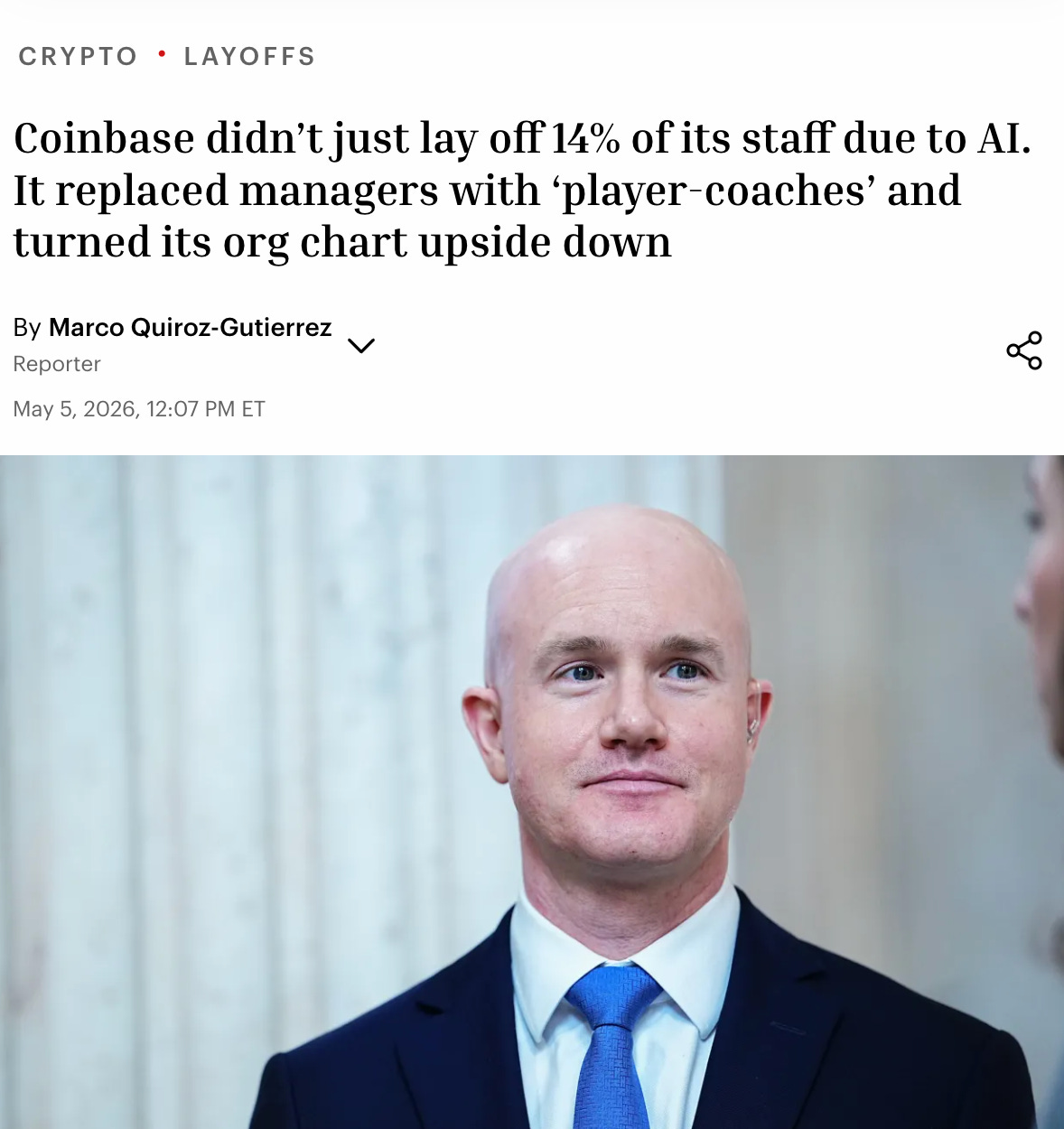
Source: Fortune coverage of Coinbase CEO Brian Armstrong’s announcement
Companies like Block and Coinbase, and most large organizations, probably should have fewer layers. Frontline managers should be player-coaches who are deep in the craft. That’s been the model in good tech firms for decades. Apple has made famous the demand for functional expertise all the way up to SVPs.
But the surgery these CEOs are running isn’t the answer. It treats symptoms while leaving the disease intact. Worse, it points to AI as the solution before the proof exists. The cost is paid in trust and engagement, neither of which comes back quickly.
What’s actually broken
There are two real problems lurking under most delayering announcements.
The first is management drift. Companies hire too many managers who aren’t deep enough in their function. People get promoted to retain them in tight labor markets, not because there’s a business need for another director. Paper cuts that accumulate over years.
Even at Slack, in our relatively brief decade as an independent company, at one point we hired a stretch of engineering managers who weren’t technical enough. Competent leaders, but not capable of solving the hard problems. The fix wasn’t radical surgery, it was changing hiring standards and being clear in performance conversations about what needed to change.
The second is too many layers, and the “coordination tax” that comes with them. Brian Armstrong is right that layers slow things down. He’s wrong about the cause. Layers obscure issues: Engineers see technical debt accumulating, marketers see the latest creative falling flat, salespeople know their messaging isn’t landing. Challenges tamped down by the bureaucracy of approvals.
Blame for that lays at the feet of senior leadership, not the middle. When’s the last time you got off the balcony and onto the dance floor? Watched a customer experience up close? Sat with the team grinding through a quarterly close? The fault sits with leadership culture.
Bad news doesn’t travel up because escalations don’t get resolved, accountability at the top is missing, or messengers get shot. Probably all three. Would you actually know? Really?
Moving boxes won’t fix it
I wrote a couple months ago about Phil Le-Brun and Jana Werner’s research: only 12% of transformations create sustained performance gains. The reason has nothing to do with strategy. It’s that leaders default to changing artifacts: org charts, process flows, approval chains. They don’t change the behaviors that produce them.
“The go-to approach for most leaders is changing artifacts,” Werner told me, “like using a PowerPoint where you move lines. What’s much harder to change, but what works, is when you get the switch in mindset that then trickles into a different behavior.”
Cutting layers is moving boxes, but it feels like doing something. You can announce it to Wall Street! Two years later when the company isn’t faster, you can do it again. Progress. Meanwhile, trust burns to the ground.
What it doesn’t do is fix the things that actually slow organizations down.
What has to come first
If you really want fewer layers, smaller teams, and player-coaches who can leverage AI, there’s no shortcut. There will eventually be such a thing as institutional AI: infrastructure that orchestrates work across teams, not just at the individual level. Getting there requires actual work.
Build a real knowledge base. Organizational AI needs accurate ground truth, not six versions of the plan, fifteen threads on how product releases work, and a pile of contradictory content guidelines. I’ve talked with plenty of firms recently grappling with the truth that their “knowledge management” system is finding the right human.
Earn alignment through transparency. Moving faster requires shared goals and transparent progress, which requires a culture that supports honest reporting versus the happy story management wants to hear.
Document workflows and decisions. If your processes live in someone’s head and decision rights are unclear, no AI is going to help. Delayering without this just means more people at lower levels trying to figure out whose blessing they need.
Define the actual job of a manager. Manager-as-router should go away, but that’s not what good managers are. Good managers are leaders who create clarity, build trust, and unlock performance.1 They help people develop skills, lead through change, and hold people accountable to results.2 That job isn’t going away, and right now it’s more critical than ever.
The founder fantasy
What I’ve outlined above doesn’t show up in what’s happening at Block or Coinbase. The cuts come first, and the hope is that reduced staff and fewer layers will move faster on their own.
The version I hear from more than a few executives is more revealing: founder CEOs who want to get back to the eight-person team that started the company a decade ago. Maybe the other 5,000 employees can be replaced by AI agents? CEOs who want everyone to trust them, listen to them, and do what they’re told because dammit, they were right early on and they’re right now.
Trust is a two-way street. The version where everyone trusts the CEO is the easy direction. The CEO trusting people enough to hear what’s actually happening is the hard one. It’s not coming from leaders who think their team is replaceable.
Leaders quietly assuming humans and AI agents will be interchangeable, down to a lack of actual emotion, passion, and purpose.
That assumption sends a message to the people who care, who want their work to mean something: don’t. Care less.
Stop telling people to care less
Raw Signal Group put it better than I can:
Care less is not the answer to a problem. It’s organizational inflammation. It’s sustained moral injury. It’s the absence of psychological safety. The undermining of high-trust, high-performing teams. It’s a gaping hole where judgement and quality and excellence go.
We’ve spent the last few years watching what command-and-control does to organizations. Engagement is at a low. Top AI users are twice as likely to quit. Middle manager burnout in tech is at 59%. The signal coming from the top is that humans are interchangeable, replaceable, and shouldn’t get too attached.
The signal coming back is that people are checking out, or leaving, probably both.
Coda
I used to get calls that started “my CEO just went to a CEO event and he’s hot on return to office.” Now, it’s “my CEO just read Dorsey’s memo (or met with him) and he’s hot to cut heads.”
You could send him this (my DMs are open?). Or just remind him that a huge part of the magic of that eight person time wasn’t that it was small. It’s that everyone was aligned, that you had clear goals, there was meaning behind the work, that you were on a mission.
Exactly the messages that get stripped away when you treat people like they’re interchangeable with technology.
If you're carrying 10+ direct reports right now: what would actually make you a player-coach instead of just a player hoping to make it through Friday?
If you’re frustrated by ineffective layers of management: what’s your take on root causes?
Let me know!
Footnotes
1 Slack’s People team had some rockstars who built the best management training I saw in decades, centered around three simple pillars: create clarity, build trust and unlock performance. If enough folks write to me and ask, I’ll find a way to resuscitate what they built (and thank them for it).
2 Want to avoid people who shouldn’t be managers going for it because it’s the only way up? Years ago I wrote for HBR about expert tracks: paths up that don’t require tucking experts under people who don’t want to manage. Most companies still haven’t built them.
Like Work Forward?
Please like ❤️, subscribe 📨, and (most of all) share 🔄
Yes, we are 🫠
Great read, Brian!