
"The biggest warning signal I've ever seen"
When you like your AI more than your human colleagues

Earlier this week, I wrote about societal fracture—how wealth inequality and broken systems are pushing us toward a breaking point. The same forces tearing apart society are tearing apart workplaces. Doubling down seems especially risky.
Today, let’s look at what’s happening inside organizations—something leaders can directly control. And they need to—fast.
The warning signal we’re ignoring
“This is one of the biggest warning signals I’ve ever seen in any of the research I’ve conducted on AI over the last 12 years,” Kelly Monahan told me recently. “There’s something fundamentally broken in the way we are relating to each other within our organizations.”
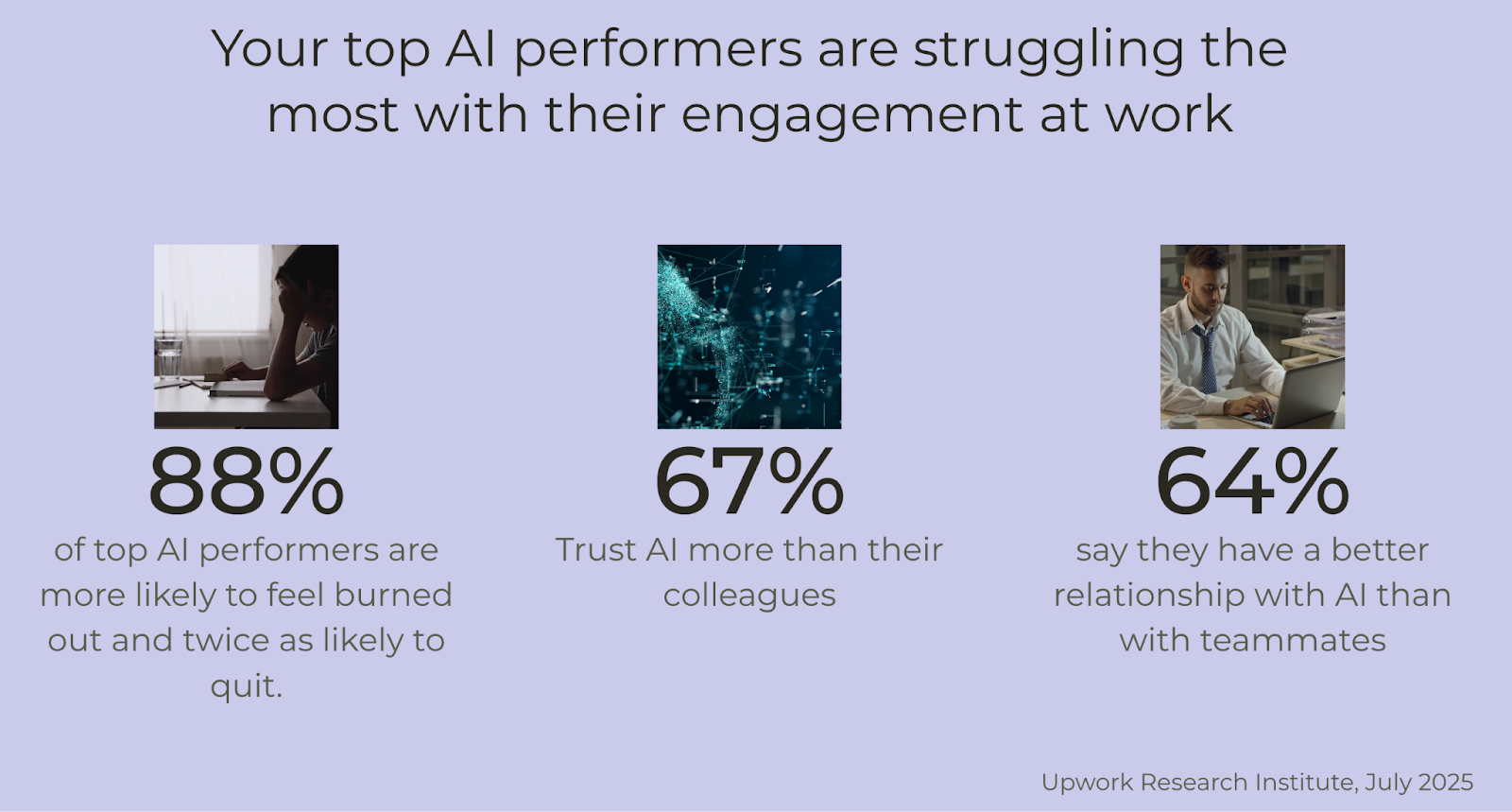
Monahan led research from Upwork that should terrify every executive: the employees getting the biggest productivity gains from AI are also twice as likely to quit. These aren’t people being displaced by automation. They’re your top performers—the ones who’ve figured out how to leverage AI tools effectively. The most marketable ones, the ones you want to keep.
Source: Upwork research August 2025
But here’s where it gets scary on a societal level: these high-performing AI users have 88% higher burnout rates and are reporting they’d rather chat with ChatGPT than their colleagues. They’re not leaving because AI is replacing them. They’re leaving because the demands to crank up output are destroying human connection.
As Brene Brown recently said, “If you’re leading people, you probably know people are not okay.”
She’s right. Microsoft found that 68% of workers are struggling with the pace and volume of work. We’re in the era of “do more with less” and the “infinite workday.”

Middle manager crash coming?
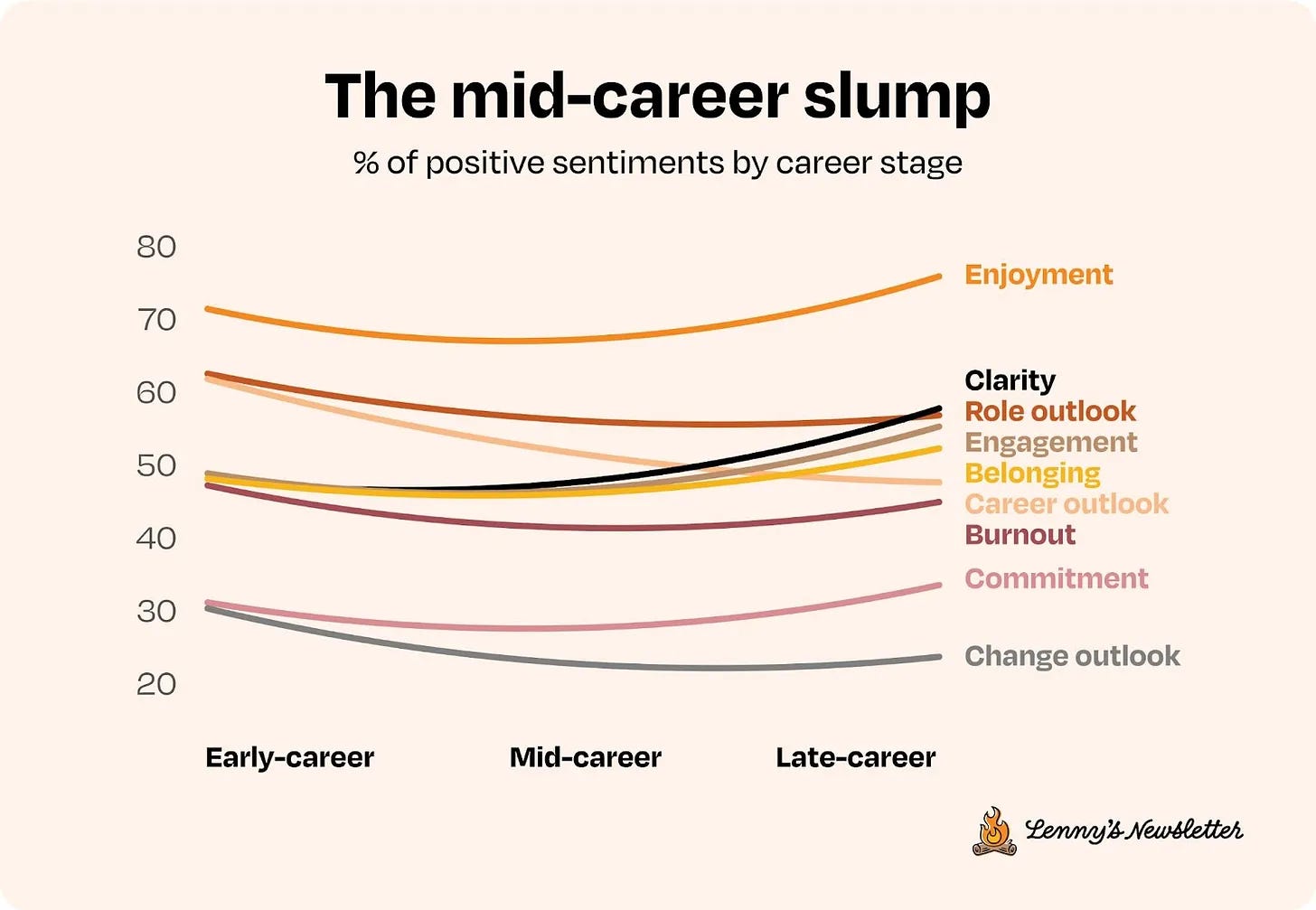
The burnout isn’t evenly distributed. The group suffering most? Middle managers. I’ve seen it in every recent research study and it’s shown up in every company I’ve advised recently: the growing rift between executives and middle managers, the disengagement and burnout. Monahan said it was true in the Upwork research as well: heavy users of AI who were also managers had it the worst of all.
Source: Lenny’s Newsletter
We’ve “de-layered” management, creating 1.6X more direct reports on average. We’ve demanded more of their teams while passing down new policies without justification. No wonder 59% of mid-career employees report significant burnout, compared to 45% overall.
More load, fewer hours for learning and coaching—right when those leadership layers matter most. You can’t expect AI to enhance management if people aren’t equipped to adopt AI in the first place.
I suspect the answers are shifting for early career workers: between the challenges of finding employment and the increasing reports of GenZ finding themselves in desk jobs ruled by stopwatches and rising costs, it’s not surprising that young worker despair has been rising for a decade, or that for the younger generation, support for capitalism has dropped from 66% in 2010 to ~50%.
Two visions of the future: one wants people
The question isn’t whether AI will reshape work. It’s whether leaders will use it to lift people up or grind them down.
Consider two contrasting approaches:
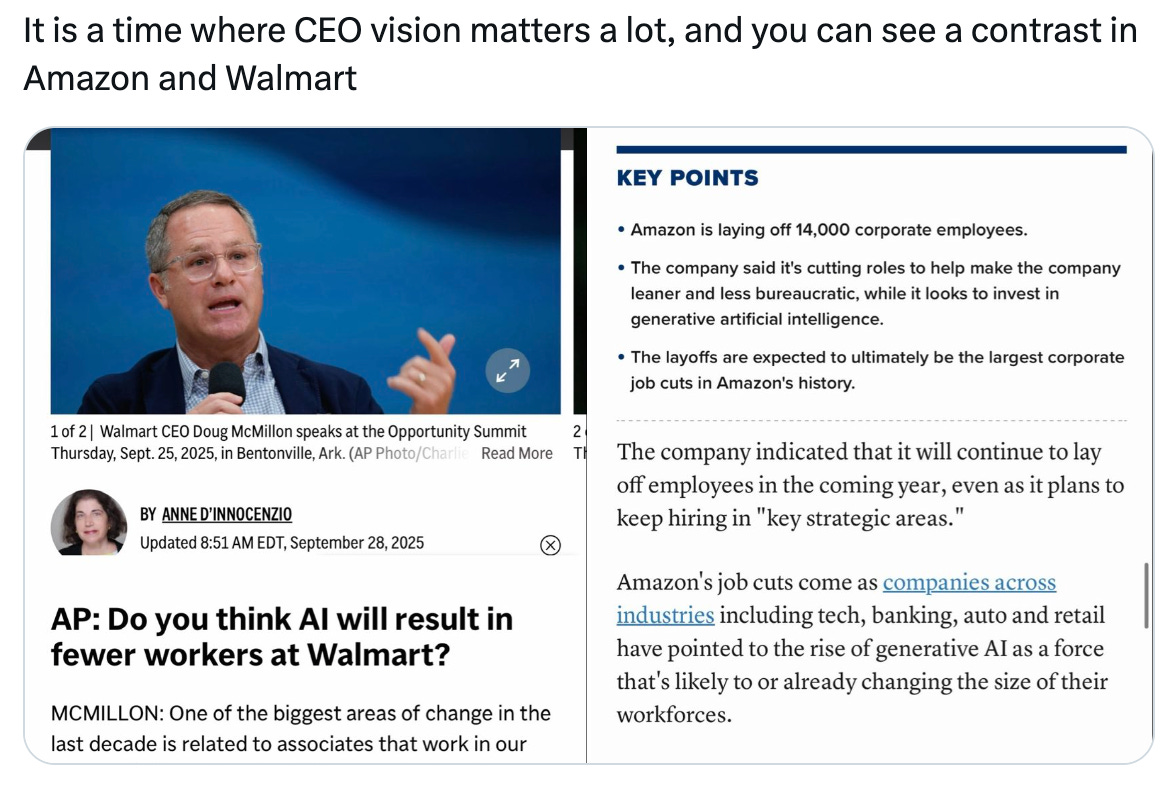
Walmart CEO Doug McMillon says AI will create as many jobs as it eliminates at Walmart, and they’ll invest in employees’ skills. “What we want to do is equip everybody to be able to make the most of the new tools that are available, learn, adapt, add value, drive growth—and still be a really large employer years from now.”
Accenture, meanwhile, is laying off 11,000 people it believes can’t be reskilled. Announcements from Amazon have been followed by Andy Jassy pointing to culture, but Big Tech’s layoff spree still has AI at its heart. As a recent headline put it, AI isn’t replacing jobs, but AI spending is.
The difference? CEO vision. As AI researcher Ethan Mollick noted:
“In discussions of AI and jobs, we put too much emphasis on the technology and not enough on the corporate leaders who are actually making decisions about what they want to do with AI. CEO vision matters.”
Source: Ethan Mollick
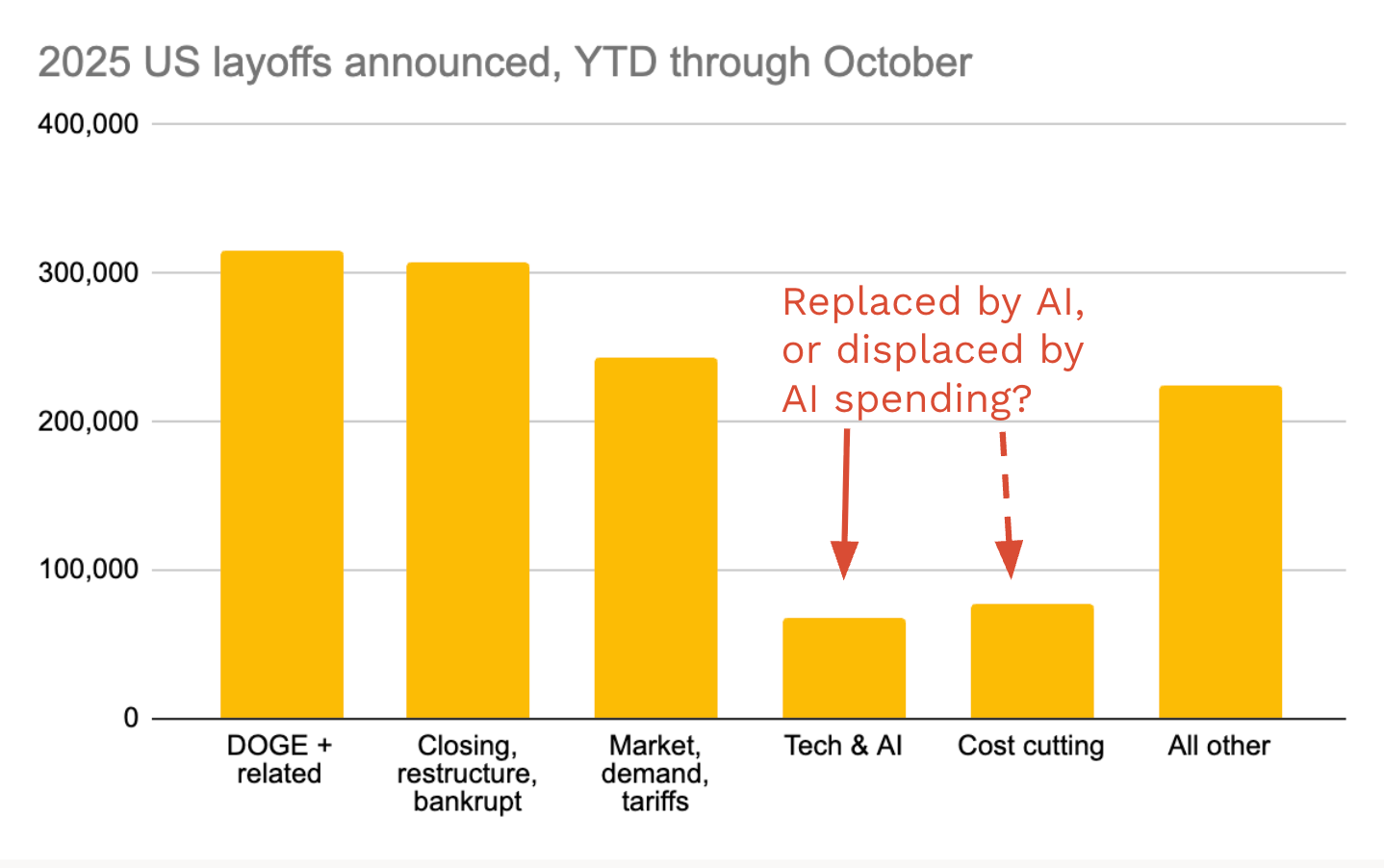
AI-driven layoffs spiked in October to over 30k—20% of last month’s announcements, but still only 6% overall year to date. Economic uncertainty, tariffs and trade concerns have now overtaken the DOGE cuts in terms of impact—and far outstrip AI.
Source: Challenger Grey October 2025
But AI can also be a scapegoat, as economist Robert Armstrong laid out in the Financial Times:
“Putting lay-offs down to AI sounds better than saying ‘we need to keep margins high so we’re sacking some low performers’ and politically safer than saying ‘unpredictable Trump tariff policy means we are hiring less young people.’”
Leadership has to change
Organizations can be safe havens. As Harvard’s Amy Edmondson recently put it, “Perhaps organizational life can offer some shelter from the chaos and uncertainty by being a safe haven where people can connect, be known, and achieve something meaningful together.”
But that requires leaders who aren’t falling into command-and-control tough-talking CEO mode. Research from CultureAmp is clear: people don’t leave bad managers—they leave bad leaders.
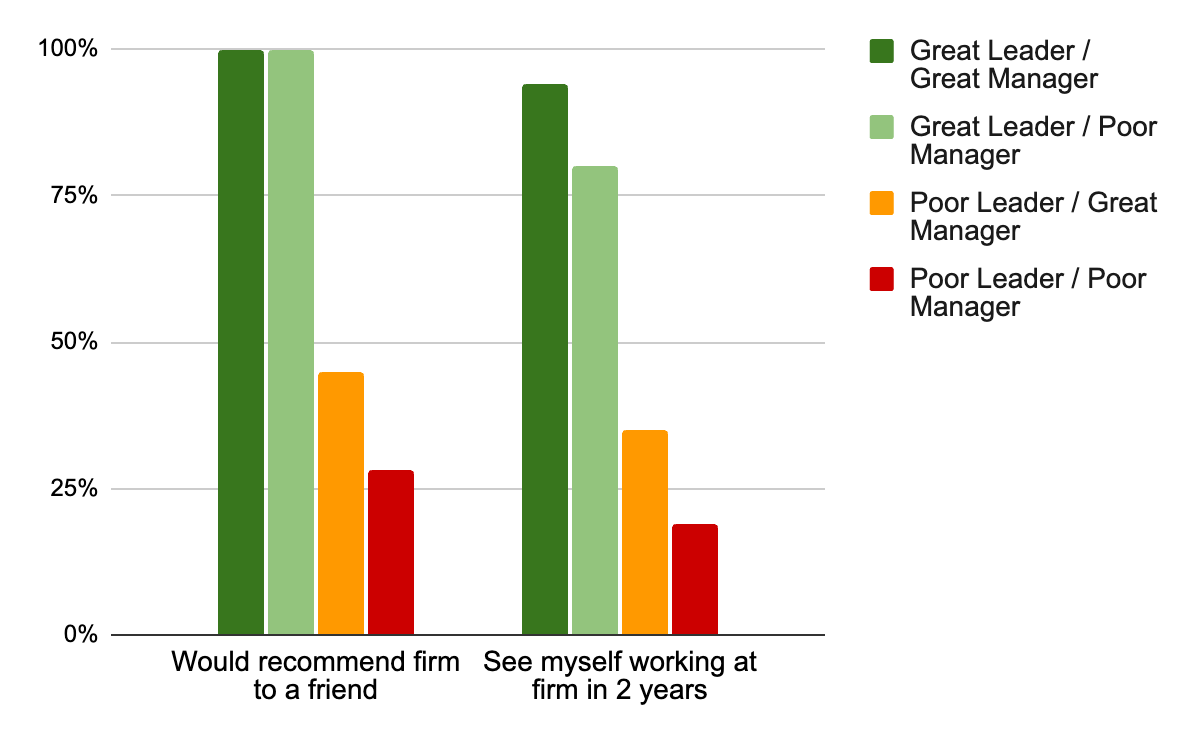
Source: CultureAmp, 2025
Leaders resorting to 1920s style command-and-control, married with some Mad Men-style culture elements and now trying to drive efficiency gains through raising output demands, forcing adoption of AI, workshop and all. We’ve established that their best AI performers are 88% more likely to be burned out. That their middle managers are crispy. That entry level employees would just as soon be unemployed, and their frontline counterparts scrambling for shifts.
I asked Kelly Monahan, author of the leadership book Essential, where we go from here.
“I think it needs to break, Brian. I think something new needs to emerge... We’re building resiliency on broken systems, and I think that’s why it’s ultimately fouling us. I think there is... a lot of brokenness in the way that we’ve created and developed some of these systems.”
Don’t think a breakdown is possible? Our systems are fragile. It doesn’t take many workers stepping away to create an AWS outage that lasts longer, air traffic controllers out sick leading to delays (or worse). Even if it doesn’t break, we’re creating the dynamics in too many organizations where we want people to do what they’re told—when agility and creativity are needed more than ever.
Another path forward
The path forward isn’t about tweaking policies or adding wellness programs. It requires fundamentally rethinking how organizations operate. Here are a few examples:
Think long term potential, not short term profit. Research shows that people-centric organizations are seven times more likely to be further along in their adoption of AI. Step back from ratcheting up efficiency goals and focus on growth and innovation: firms that do so are more likely to see positive returns on AI investments.
Build learning-based organizations. Reward curiosity and experimentation, even when it means sacrificing short-term efficiency for long-term capability. Create cultures that support weird ideas from people who don’t look like you. As Amy Edmondson notes, psychological safety isn’t just nice-to-have—it’s the foundation for the adaptability organizations need to survive.
Get flexible. I don’t just mean distributed teams or asynchronous collaboration. Organizations need dynamic, fluid planning cycles: set audacious long-term goals with quarterly checkpoints. Fund teams for quarters, not a week or eternally. When the work shifts, the teams shift too—without the bureaucracy of a reorganization.
Reward teams, not individuals. Work today is creative, cross-functional, and complex—teams are where value is created. Shift performance systems to measure team outcomes, not individual heroics. Yes, this is harder than stack-ranking people, but it’s also where real value is created. Instead of sweating the free rider, sweat the dynamics that create great work.
Break leadership norms. All of the above requires a dramatic shift away from traditional leadership tropes. Transparency and agility over heirarchy and control. Trust and accountability over oversight. Most importantly, EQ over IQ.
There’s a lot more to unpack in each of these shifts. If you want me to dig deeper into any of them, let me know in the comments, or drop me a line: brian@workforward.com
Related Reading
My latest for Charter lays out how a product management approach to work can help boost results by focusing on employee satisfaction as well as outcomes, and why builders are the key to unlocking AI’s potential in teams—and features fantastic insights from Women Defining AI co-founder Helen Kupp!
The rise of hustle culture and resurgence of AI startups almost all helmed by men is the topic for Erin Grau’s latest. Speed is absolutely an issue in the AI race; but performative facetime shouldn’t be. “How we pursue speed defines who benefits from it, and the women in the room want to prove that moving fast and leading well don’t have to be at odds.”
Hybrid Work Is Not the Problem — Poor Leadership Is
That’s the headline for my first published work alongside professors Nick Bloom and Prithwiraj (Raj) Choudhury, two long-time partners and incredible academics. If you’re missing my usual forays into the latest and greatest when it comes to flexible work, don’t miss this one. Maybe pass it along to anyone reading “In Defense of the Office.”
Coda
On a personal note, the most wonderful dog in the world left us this week. Yuki grew up with our kids, was our packmate and an amazing companion. Give someone you love a hug today and let them know how much you love them.

Very sorry for the loss of your packmate. They are the best of us.
100% agree with this. It is (as always) down to leadership.
And organizations need to ground themselves in why they invest in AI, why are we making this change? Far too many slams a bit of AI on top without proper support to managers within the organisation.