
The year we start building back
Looking back on 2025, forward to 2026.

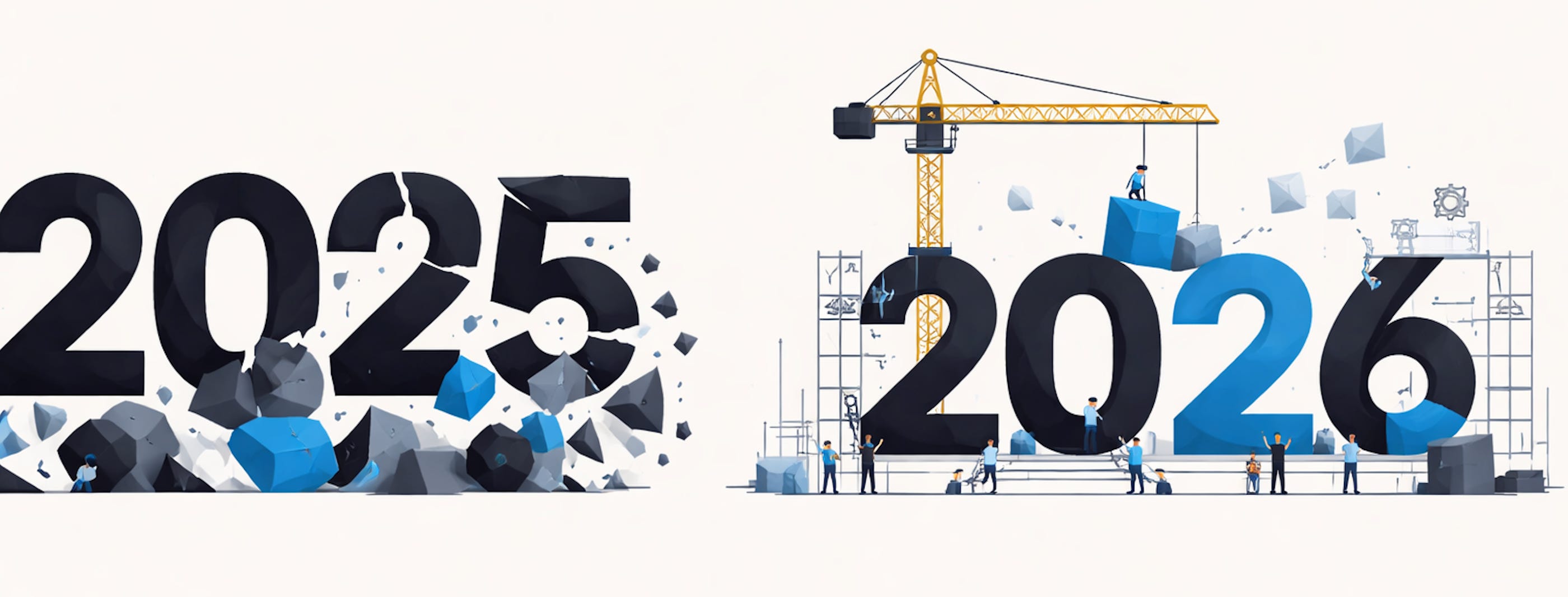
In 2025, many CEOs stopped pretending to care about things they never really cared about.
Employee wellbeing? Out. Long-term thinking? Gone. Building capabilities instead of cutting costs? Please. The tough-talking CEO swagger came roaring back, and with it came rank-and-yank performance reviews, rigid RTO mandates, and AI pitched as a headcount reduction strategy.
At a Yale School of Management gathering in December, 66% of CEOs said they’re planning to freeze or cut headcount in 2026. “You’re going to see a lot of wait and see,” Chris Layden, chief executive of staffing company Kelly Services, explained. “We’re going to continue to see an investment in capital over people.”
Translation: We’d rather buy machines than develop humans.
Big Tech leaders fell in line with the incoming Trump administration. No surprise there: as a friend noted, they’ve spent decades chasing each other around the Monopoly board. But the broader business community went quiet too. Heads down. Private dinner conversations that never made it to public statements.
My most-read column of the year captured this moment: It doesn’t feel like our country is heading in the right direction. The piece struck a nerve because it named what many were thinking but few were saying: leadership at many levels is choosing short-term performance over long-term value. The tough talking leader destroys long-term value, and rank-and-yank creates internal competition, not market winners.
What we lost was trust. Trust in government, and trust in business for the first time in decades.
The loss of trust in government wasn’t accidental—it was strategic. It’s easier to fulfill Grover Norquist’s desire to “reduce government to the size where I can drag it into the bathroom and drown it in the bathtub” if people believe it’s all fraud and waste. The impact is coming: dismantling USAID eliminated soft power advantages for the US and is forecast to result in 14 million deaths globally by 2030. The domestic consequences of dismantling agencies and social safety nets will pile up in 2026.
Inside companies, the trust collapse was more knee-jerk. Too many CEOs felt they’d overcorrected during the pandemic—too employee-centric, pressured into what were too often performative DEI efforts. When power snapped back, so did they. DEI became a four-letter word. Some companies swapped it for “belonging”—same intent, better branding. Others just dropped the pretense entirely.
In 2026, leaders again face a choice: keep playing the tough-talking leader game, leverage fears of AI displacing workers to keep people in line. Or understand that fear doesn’t build great outcomes, that you have more opportunity to drive better results by focusing on upside than downside. Build from hope instead of fear.

Work Forward is a newsletter dedicated to building a better future of work for people and organizations.
If you like what you’re reading, please like ❤️, subscribe 📨, and share 🔄. Thank you!
What the data actually showed
While CEOs were performing toughness last year, the evidence kept piling up in the other direction.
AI’s impact on jobs? Limited displacement so far. But massive increases in burnout and disconnection. No wonder my columns on growth as an antidote to burnout and tech’s leadership crisis were among the most-read.
Even the AI evangelists started backing off. Salesforce executives admitted they’re pulling back on the magic beanstalk pitch—the promise that GenAI solves everything. Deterministic solutions as a base are cheaper and don’t hallucinate. Nuanced solutions that combine approaches, humans and technologies, require rethinking ways of working. That’s the type of redesign that requires human cooperation and collaboration.
That cooperation doesn’t happen in cultures where trust is busted. Low-trust strategies produce low-trust results. Rank-and-yank creates internal competition instead of market winners. RTO mandates drive down engagement and drive away your best performers. Cost-cutting AI strategies miss the growth opportunities.
MIT economist Erik Brynjolfsson explained why the reductivist cost-based approach is the relative loser in a recent interview. He points out that cost leadership strategies worsen initial productivity declines, but market expansion approaches drive growth that offsets the investments needed to leverage a technology as fundamental as AI.
As he puts it, business leaders keep underestimating “the value of intangibles—new business processes, new skills, new ways of organizing work.” Those investments need to be 10X larger than the technology spend. It’s not 70% change management. It’s 90% about engagement, workflows, EQ and trust.
Which brings us back to the return-to-office wars.
Flexibility builds AI muscles
Discussions about remote work didn’t go away in 2025, to the consternation of many CEOs—hence why we can’t stop talking about it nearly six years later.
But the data got clearer. Hybrid Work Is Not the Problem — Poor Leadership Is tapped the latest research showing why hybrid works, and made MIT’s top 10 of 2025 despite publishing in Q4. The related interview hit MIT’s top 5 videos. At this point, your CEO’s push for five days in the office signals either a desire to crank up voluntary attrition or straight-up narcissism. Probably both.
Evidence mounted that mastering hybrid is an AI advantage. Teams that redesign how they work get advantages from flexibility that full-RTO companies leave on the table. The same skills needed to experiment with new ways of working play out in AI adoption: workflow redesign, document-driven thinking, clear goals and, most of all, engaged employees.
Organizations drowning in complexity need human judgment, emotional intelligence, and adaptability. Precisely the skills that rigid, control-based systems kill.
The pattern holds whether you’re talking about flexibility, AI adoption, or performance management: Trust isn’t weakness. It’s infrastructure.

Where to in 2026?
Building back trust and creating hope requires starting with what we can control: how we work, how we lead, and how we support those around us. For me, that starts with my own work.
At this stage, my resolutions are few and far between: more time with family and friends, more time to explore, and fewer, higher impact work moments. Gearing up for a 2026 that will be at least as challenging as 2025, and willing to be pleasantly surprised when it’s not.
When it comes to writing, expect less from me….but hopefully higher impact. I wrote 77 columns in 2025: 61 for Work Forward, 11 for Charter, and 5 for MIT Sloan Management Review. So many that I stopped updating my website’s resource library.
Some resonated. Many didn’t, some of it lackluster. I learned what Brynjolfsson could have told me: volume isn’t velocity.
In 2026, I’m cutting the volume. Better work, not more of it. More data-backed storytelling about leaders who are building forward with people at the center, not as cogs to be automated out of jobs.
The leaders figuring out that trust isn’t weakness, that flexibility isn’t chaos, and that humans aren’t the problem to solve: those are the ones I’m writing for.
I don’t think there’s a CEO out there who wants to make their company small enough to drown in a bathtub. So it’s on all of us to do the hard work: to manage uncertainty and lead with generosity.
That’s where I ended 2025: with a column about hope. Because hope isn’t naive optimism. It’s a magnet that pulls you toward what’s possible when you stop pretending and start building.
If that’s you, let’s see what we can do in 2026.
Recommended
Read: Wharton’s Adam Grant on Why We Fall for Narcissistic Leaders (gift article). One of my favorite people, researchers and writers, not to be missed.
Listen: If Books Could Kill is one of my favorite podcasts and their teardown of Walter Isaacson’s Elon Must hagiography is an all-time great; listen on Apple or Spotify.
Read: Marcus Weldon’s interview of Erik Brynjolfsson, mentioned earlier, is well worth your time (thanks Kevin Delaney for spotting it!)