

Contagion
When layoff culture goes viral

This one runs hotter than my usual. The subject matter earned it.
Andrew woke up at his usual time to an unusual message: His job at Oracle had been terminated overnight, and his access to all work systems (and his coworkers) was gone too. He didn’t find out through a call from his boss, or HR. He didn’t even learn about the termination by reading an email. He figured it out because an AI-generated summary of his inbox told him it had happened.
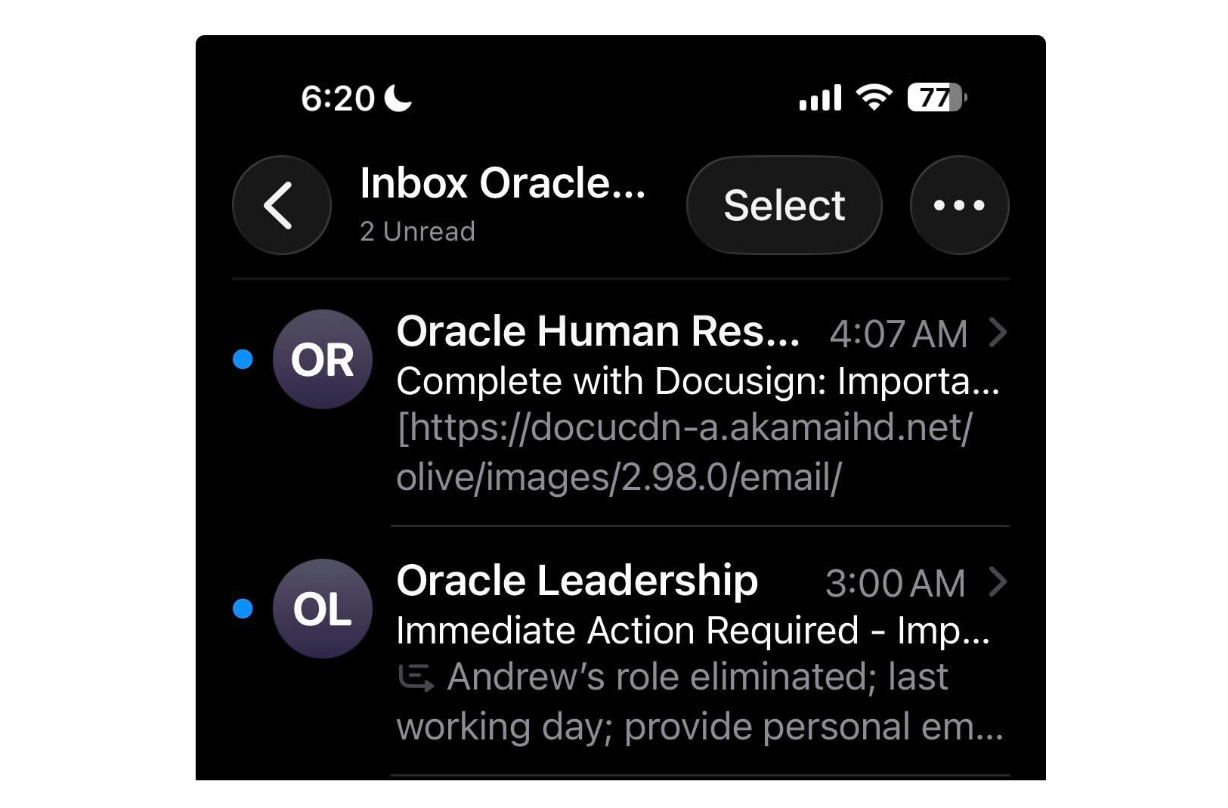
Andrew didn’t lose his job to AI, but AI is how he found out he’d lost it. Not a human, and that’s a distinction his employer apparently thought wasn’t worth making.
He was one of around 30,000 people, approximately 18% of the workforce laid off at Oracle, cut in order to continue funding AI data centers that have yet to pay off.
It’s a lesser version of the 40% of Block employees laid off a few weeks prior. In Block’s case, CEO Jack Dorsey pointed to the potential of AI to radically restructure work and his desire to get ahead of the curve; the real reasons may be tied to pandemic overhiring, sizable lawsuits and a weird dual corporate structure. But AI sounds better, especially when you’re selling AI-enabled business tools.
Recently Snap laid off 16% of its workforce and this week, news broke that Meta would be laying off another 10% of its workforce in May. Better than the rumored 20%, right? For now.
Oracle’s Larry Ellison, Block’s Jack Dorsey and Meta’s Mark Zuckerberg are among the notable tech founders now racing to see who can make the most of the AI opportunity to transform work. They may also be in a contest to see who can be the most badass when it comes to cutting people.
Predictably, the contagion is spreading. The WSJ reports this week that Block’s CFO is fielding calls asking for their playbook. I’ve heard the same from a number of people in San Francisco: the tech bros are out to see who can get aggressive the fastest in transforming their business, damn the side effects.

More cuts in tech are coming. The narrative is taking hold: AI is a human replacement technology.
Sam Altman’s house, meanwhile, had a molotov cocktail thrown at it. Sam blamed the New Yorker profile of him for being “inflammatory.” It’s more likely the person who threw it heard Sam say AI poses a risk of extinction to humanity, was influenced by tech layoffs tied to AI, or saw an AI-will-replace-workers bus stop ad. Perhaps all of the above.
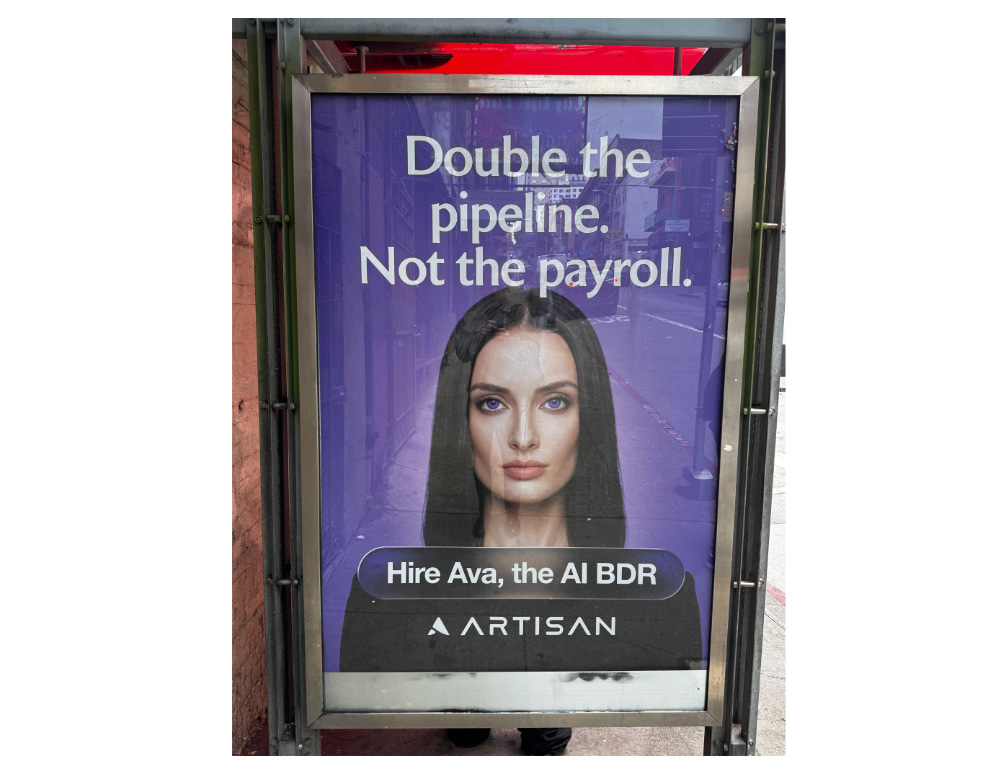
Throwing a molotov cocktail at Altman’s house is inexcusable. But we live in a society where narratives get amplified, translated, and sometimes acted on.
The contagion is spreading beyond tech: Verizon CEO Dan Schulman is sticking to his prediction of 20-30% unemployment in the coming 2-3 years. The consequences of that would be massive in a well-functioning country: massive unemployment, a recession, and the potential for civil unrest.
We don’t live in a well-functioning country.
There are alternatives, and it’s not too late to take a different approach. Let’s take a look at the expanding narrative, what the latest research tells us, and where we might go instead.
How the narrative spreads
The WSJ coverage of the Block-inspired contagion points out that the cause isn’t really AI’s ability to replace workers, it’s the need to cover the costs of AI, and a convenient excuse:
“Most companies, if not all, could cut 30% to 50% of their workforce at any time and see no material difference in performance,” said Mo Koyfman, founder of the venture-capital firm Shine Capital and a former executive at the media company IAC.
Sure, artificial intelligence has made some work processes more efficient, allowing for fewer people in some departments, he said. But “it also has given air cover, more importantly, to execute on the right sizing that you probably needed to do a long time ago.”
Koyfman’s take is rooted in tech’s past excesses; overbaked and out of date. When I worked at Google at the height of its talent-hoarding period, a coworker and I used to joke that if half the workforce disappeared tomorrow, the firm would recover within weeks. Several years of continual layoffs and a raising of the performance bar later, that’s no longer true at Google. But that doesn’t stop CEOs from having vibes.
It’s no longer just the tech founders. Verizon’s CEO Dan Schulman doesn’t have the same incentives as the tech bro crew: Verizon isn’t out selling AI-enabled tools. But he’s sticking by the prediction of 20-30% unemployment that he first stated at Davos.
The good news: Verizon is launching a $20 million career-transition and retraining fund for the “age of AI.” The bad news: that pales in comparison to their targeted $9 billion in cost reductions. The WSJ also reports that Schulman “recommended that staff ask AI to write their obituary to see how the technology works and how it frames their lives.” Maybe start with an obit for your job?
Unsurprisingly, Wall Street is shifting its tone from enhancement to replacement of humans. Here is Bank of America CEO Brian Moynihan’s shift over the last four months:
Less than four months ago, Bank of America’s chief executive, Brian T. Moynihan, volunteered in a TV interview what he would say to his 210,000 employees about the chance of artificial intelligence replacing human work.
“You don’t have to worry,” he said. “It’s not a threat to their jobs.”
Last week, after Bank of America reported $8.6 billion in profit for the first quarter — $1.6 billion more than the same period a year earlier — Mr. Moynihan struck a different tone.
The bank’s bottom line, he said, was helped by shedding 1,000 jobs through attrition by “eliminating work and applying technology,” which he repeatedly specified was artificial intelligence. He predicted more of that in the months and years to come.
I doubt CEOs like Moynihan and Schulman share the dreams of many tech founders, many of whom would love to be in charge of a multi-trillion enterprise with a team of eight people, or perhaps larger but with no managers in the middle and an AI instructing the humans below. But they do see the dollar signs that tech companies are floating by cutting ruthlessly.
What the research actually says
The narrative is coming primarily from mega-corporations: the biggest companies that often are bureaucratic, bloated and slow moving. The ones where the cuts aren’t necessarily enabled by AI, but it is a convenient excuse.
The actual research tells a different story. New BCG research analyzed 1,500 jobs and found that 10-15% could be eliminated over four to five years. The number that gets less airtime is that 50-55% of jobs will be restructured: AI giving workers new skills and capabilities, requiring significant changes to how teams, functions, and organizations operate. That’s the real story, and it’s a multi-year transformation, not a quarterly cost-cutting exercise.
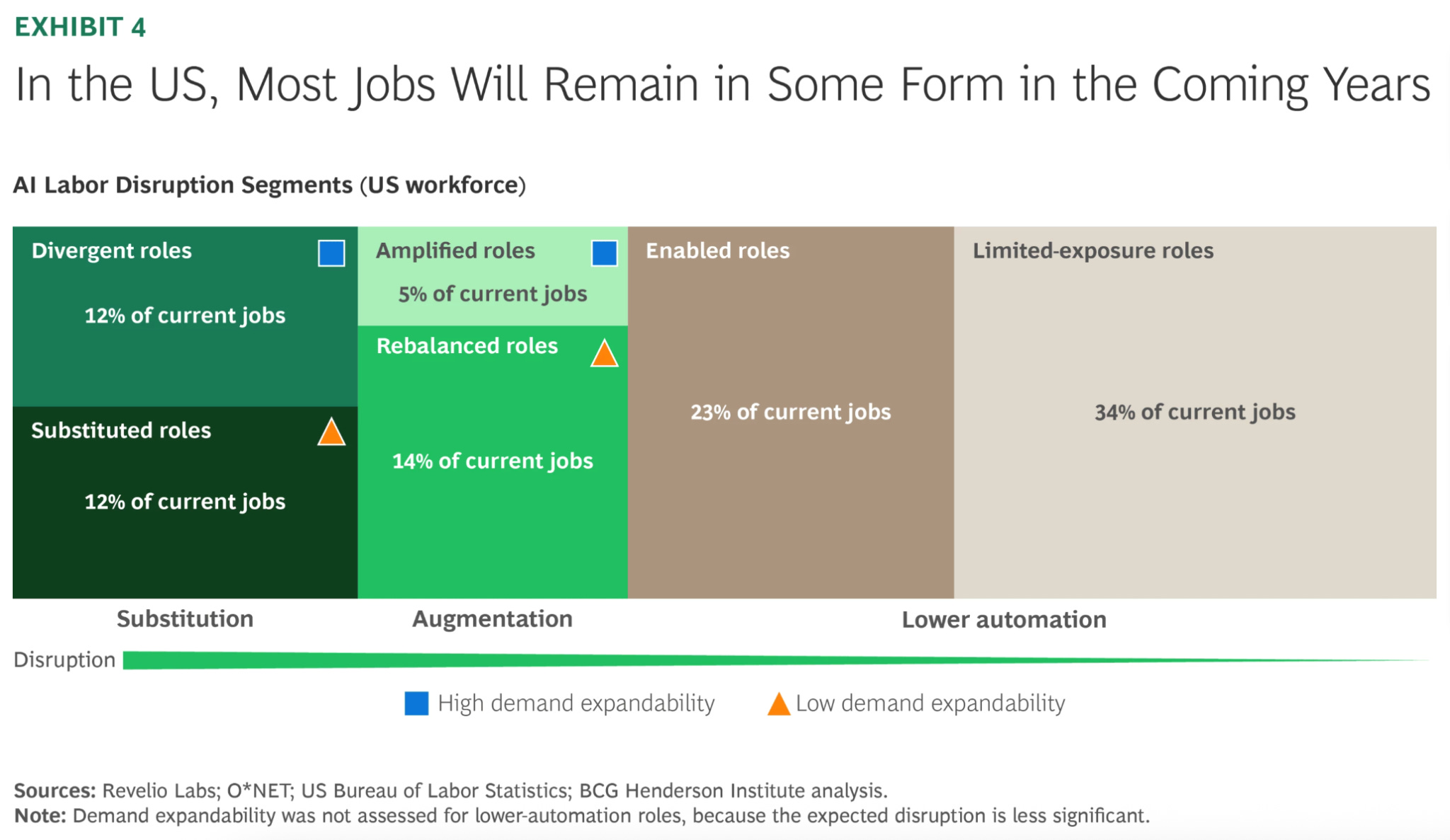
Source: AI Will Reshape More Jobs than It Replaces
That also doesn’t translate to an unemployment increase of 10-15%, since other roles will be expanding. One that’s surprising to many: software developers. While AI dramatically impacts the act of writing code, that also unlocks demand: an engineer with AI can do far more than a human alone, making the combination “cheaper” for business. I covered this more extensively in Charter this week.
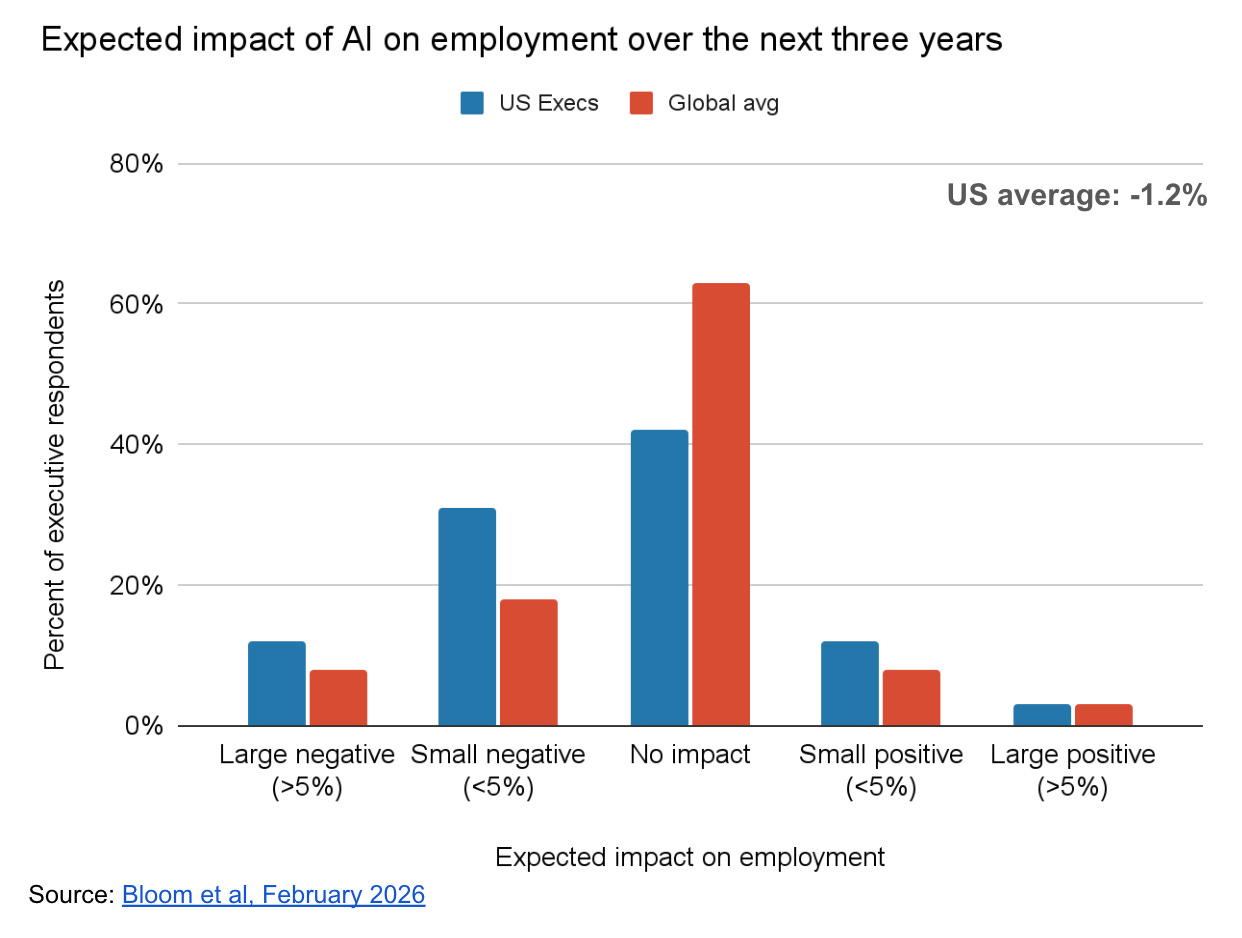
Nick Bloom’s research, tapping surveys of executives across the Federal Reserve, Bank of England, and others, found that 26% of executives predict decreased employment over the next three years due to AI. In the US, that number jumps to 43%.
But 15% of US executives expect employment to grow because of AI. Net those together and you get a predicted decline of 1.2%. That’s not nothing: 1.2% of US employment is around two million jobs. But it’s a far cry from the 20-30% unemployment Schulman is predicting, or the workforce-ending vision some tech providers are selling. The loudest voices are not the representative voices.
A Gallup survey released in April points to the mega-corp difference: among AI-adopting firms, it’s only those with more than 10,000 employees where they’re more likely to be cutting heads (33%) than expanding employment (30%). Even among 5-10,000 employee firms, expansion (38%) is sizably outpacing cuts (23%).
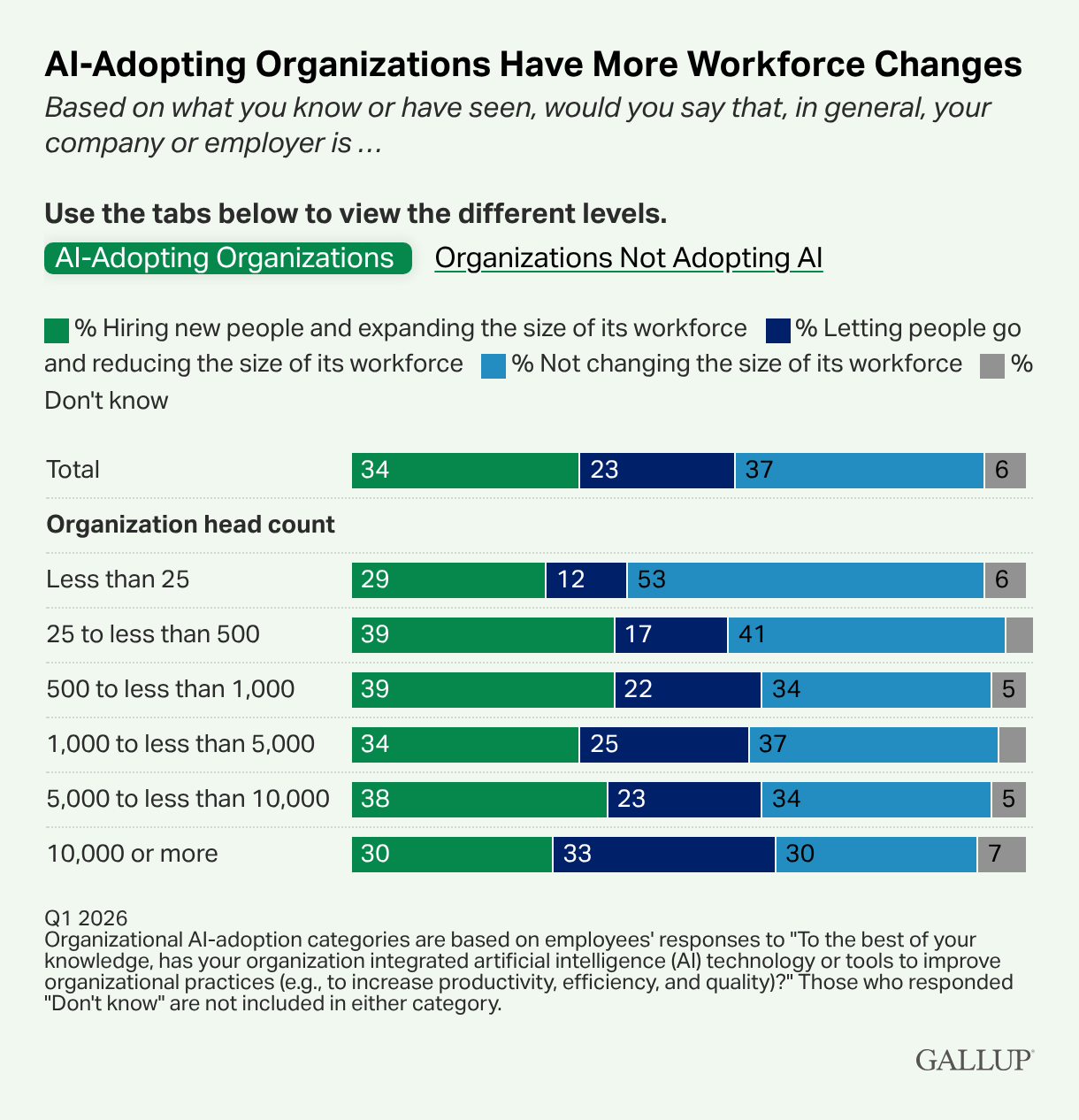
Source: Rising AI Adoption Spurs Workforce Changes
AI has the potential to accelerate the Innovator’s Dilemma: large incumbents who simply cannot adapt fast enough, focusing instead on cost reductions, see their lifespans reduced by smaller firms who can leverage AI to eat their lunch.
In Europe, AI is actually causing employment to increase. The European Central Bank (ECB) looked at 5,000 firms and found that those who make intensive use of AI are about 4% more likely to hire new staff than average. Firms planning AI investment had more positive hiring expectations for the coming year, regardless of investment size.
Only 15% of AI-using firms cited “reducing labor costs” as a motivation. More firms are hiring because of AI: to develop and implement it, or because AI lets them scale faster. Some of this might be short-lived: the ifo Institute found that over the next five years, 27% of German firms expected to decrease employment, while only 5% expect to add over that timeframe.
Beyond “let’s move to Europe,” what might be going on here? Maybe it’s a word CEOs love: ambition.
Treatment options
There are alternatives to the AI-as-replacement narrative.
Leverage AI with ambition. The word “ambition” can be troubling: words like “hardcore” and “aggressive” come along with it. But so do words like growth, expansion, and winning. No founder ever stood up and proclaimed their success was due to their ability to cut: it was their ability to think expansively.
Instead of measuring individual AI usage and whacking those lowest in output, why not set ambitious goals, give teams time and space to experiment, and go steal share away from corporate behemoths who can’t move as fast because their people are punching the clock?
Focus on teams. Output at the individual level doesn’t lead to outcomes. At many early adopters I’ve talked with, individual productivity gains haven’t moved the needle because people aren’t aligned: goals get set at the personal level, not the team level. “The real value of AI comes at the team level,” says Atlassian lead behavioral scientist Ben Ostrowski. “Teams are where work has always been done.”
Recognize the risks. Your heaviest AI users are also your most likely AI Brain Fry candidates: cognitively overloaded, marshaling oversight beyond their capacity. BCG research found they’re 39% more likely to commit major errors and show 39% higher intent to quit. The super-users driving 10x output are the same people most likely to walk out the door. Push them harder and you’re not gaining productivity, you’re just accelerating attrition in the people you can least afford to lose.
Play the long game. CEOs too often sweat next quarter’s earnings. But as one Charter Forum member noted in a recent session, she’s helping her team take the long perspective:
“I’m intentional about giving historical examples. When ATMs were introduced, we thought that was the end of tellers forever. What happened was they actually increased in number, but the work changed: they became customer service reps. We try to take the scare factor out, to make the mountain ahead of us not look like Kilimanjaro.”
Provide paths, not promises. As I’ve noted before, customer support is the most-targeted function when it comes to AI replacement, and firms like Anthropic, Guild, and Zapier supported employees through training, time, and pointing to new open roles. Not making them a promise of employment, but pointing to a path forward.
Coda
Andrew found out he was fired from an AI summary of his inbox. That was a choice by someone at Oracle who decided it was faster and more expedient. That’s not about AI: AI is the excuse, and sometimes the delivery mechanism.
Leaders face choices. At a minimum, whether to treat people like they matter. More meaningfully, if they follow the narrative of AI as replacement.
Somewhere in the alternatives above is a version of the next few years where more companies choose differently. Where they go for ambitious growth instead of ambitious reduction. Where at least a few tech leaders work to change the narrative before it’s too late.
If the contagion keeps spreading, we’ll find out what a society looks like when a critical mass of workers learn they were disposable from a chatbot. I don’t want to find out. Neither, I suspect, does Andrew.
What are you seeing inside your own organization? Is AI genuinely reshaping work, or providing cover for cuts leadership wanted to make anyway?
What’s next
ICYMI
A thoughtful tech CEO
Duolingo CEO Luis von Ahn just backtracked on tying AI usage to performance reviews, a policy he announced with an "AI-first" memo last April. Employees kept asking: do you just want us to use AI for AI's sake?
His answer, on the Silicon Valley Girl podcast: "The most important thing in your performance is that you are doing whatever your job is as well as possible. A lot of times, AI can help you with that, but if it can't, I'm not going to force you to do that."
Engineering hiring is up, not down
Contrary to consensus (and Big Tech vibes), engineering job postings are at a three-year high. This may be Jevons paradox at work: when something becomes cheaper (engineering capacity, thanks to AI) we demand more of it.
We can accelerate roadmaps, greenlight projects previously too expensive, extend engineering capability to new parts of the business.
Sounds simple, but it's incredibly hard to do. Hiring, performance and team structures in engineering are changing rapidly, and that's just the start of massive, broader org implications.
The new constraint isn't how fast engineers can build: It's how well product managers understand customers, and how fast the rest of the organization can act.
That's cold-blooded. Wow!
Word!