

Let them eat cake
Big Tech has sold CEOs a story about AI and labor. The leaders who refuse to buy it will own the decade.

Like Work Forward? Please like ❤️, subscribe 📨, and (most of all) share 🔄
The San Francisco Bay Area now has, by one estimate, more than 10,000 people who have cleared $20 million in the last five years on the AI boom. Mass local happiness has not followed. My Monday run took me past a fresh sidewalk chalk mural, the kind of thing as likely to be scrawled by a laid-off engineer as a barista: EAT THE RICH.

I don’t think anyone wants to eat Elon Musk. He doesn’t look that tasty. But the chalk is pointing at something real, and it has little to do with envy. It’s the impact of leaders who have decided the only tool they need is the stick. It’s billionaires so scared of a one-time 5% wealth tax that they contemplated buying the ballot initiative signature-gathering company to shut it down.
Here is the part those leaders are missing.
There’s a fork in the road right now, and Big Tech is waving everyone down the wrong path. The story they’ve been selling is simple: AI makes you productive by letting you cut people. Fewer humans, same output, fatter margins. Oracle, Snowflake and Meta are running that play in public.
But as Eric Brynjolfsson put it in the NYTimes, “A lot of people are under the mistaken idea that the only way that you get productivity from A.I. is by removing labor costs.”
The CEOs who understand that, and have the guts to act on it, are the ones who will be standing on top in five years. Everyone else is optimizing for a quarter and a headline, and some are already expressing regret.
The case for swinging the axe is real. It’s also short term.
Let me give the other side its due, because the argument isn’t dumb. The labor market softened. Boards want profitability yesterday, many big companies are probably bloated and AI is a convenient excuse as well as starting to have real impact. Worker compensation as a share of gross domestic income just hit a record low, the lowest since record-keeping began in 1947, which means capital is winning, labor is losing, so the spreadsheet math says keep going.
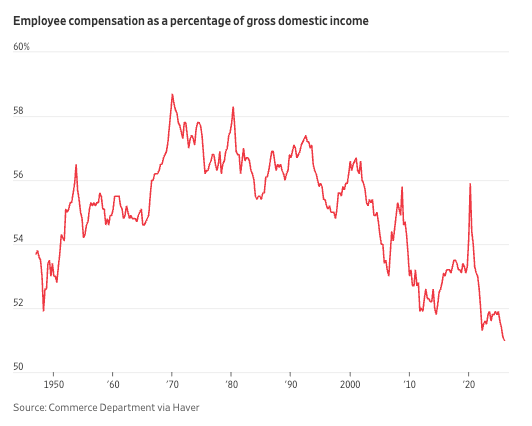
Source: WSJ May 28, 2026
If you’re a CEO under pressure, cutting heads and crediting AI looks like discipline.
So why not press the advantage?
As Greg Ip notes in the WSJ “You can be a red-blooded capitalist and still worry about the political stability of an economy in which ever more output flows toward shareholders instead of employees.”
The leaders who want to win the long game read that as a warning. Unfortunately, some read it as a green light.
Past shocks hollowed out the places I came from
The human side of the spreadsheet is getting ugly. In 2026, 34% of Americans described their financial situation as “struggling” or “in crisis,” up from 22% in 2021. That’s a 55% increase in five years. 50% of US workers now live paycheck to paycheck, up from 37% in 2020 and 42% in 2024.The numbers move in one direction, and it isn’t toward the chalk artists.
I grew up with a single mom who often lived that struggle, as did most of our town. The small midwestern town I’m from saw the coal mine go away when i was a kid, replaced by a minimum security prison long after I left.
Beth Macy’s excellent memoir, Paper Girl, describes her similar hometown and how, over a couple of decades, what the China Shock did to towns like the ones we both came from. The import surge that followed China’s entry into the global trading system hollowed out factories, then main streets, then families. The official story was that the displaced would retrain and move up; it’s a story I believed. It’s not what happened.
AI may be on that same trajectory now, as Molly Kinder lays out, and the tech narrative wants it to move faster. We lived through one shock and watched it gut the middle of the country, and I was one of those trained in schools and working in jobs that said “it’s ok, we’ll adjust.”
We’re now on the cusp of another transformation. This one can turn out differently, but only if we have the will to make it so. We cannot afford the alternative as a society.
And, it turns out, most companies can’t afford it either.
Shoot one, scare the rest
I first heard the line “shoot one, scare the rest” from a senior sales executive in an industrial automation company, who had a bit of a Glengarry Glen Ross vibe going. His boss, a former military commander, told him to knock it off: that’s not how you motivate people. The man who’d actually led people under fire understood what the sales guy didn’t.
Somebody should introduce that boss to Snowflake CIO Mike Blandina, who told a room at the company’s customer conference that he used layoffs to force engineers onto AI tools. “At the time, my team hated me, but I thought it was a provocative way”, he noted at the company’s annual customer conference in San Francisco in May.
I’ll definitely give him provocative.
Snowflake also cut its technical writing team, reportedly after those writers spent months teaching AI how they did their jobs.
The logic is clear: replace human writers with AI-generated documentation. The challenge, as I know from my time leading Slack’s Platform team, is that tech writers handle nuanced, domain-specific explanations that are critical for developer onboarding and troubleshooting—and ongoing relationships. Reputation and relationships can be key to success.
Maybe Snowflake executives got it right, or maybe they’re too distant from the work to understand what the full function provided:
“Any company that cuts its entire documentation team is telling me it does not understand how product discoverability and agent-first developer workflows work in today’s world. It is telling me that I should switch to a company that understands these things because my tools need high-quality, well-maintained documentation to succeed at the tasks I need to achieve.”
We’ll see what happens next.
The C-suite is not part of the crew
Snowflake’s got nothing on Meta.
Engagement there has cratered to the point that the CTO has called morale “near the worst it’s ever been” and described the layoffs as “atrocious.” The fix, per a recent memo: cap managers at roughly 20 direct reports and stop reshuffling people onto new managers every reorg.
So 50 reports is out. Good to know.
The grimmer moment came from chief product officer Chris Cox, who, per Wired, stood in front of Instagram staff and described the environment as brutal:
Cox applauded Instagram employees for launching features and serving around 2 billion users amid what he compared to “running a marathon in the middle of a hailstorm and then, like, your teammate gets replaced and then we’re recording you.”
“It’s like what the fuck,” he said, drawing laughs, before repeating himself. “It is like what the fuck.”
Maybe it drew laughs, but I’m pretty confident it reassured no one.
Cox is not a fellow sufferer. He’s a top executive at the company doing the squeezing. You cannot say “what the fuck” twice and join the crew you’re accountable to lead. I wrote earlier this year about four leadership skills the moment requires, and two of them are presence and courage. Presence means being close enough to the work to fix it locally, not narrating the pain from the balcony. Cox has reportedly urged leadership to get back in touch with employees, but courage means leaving if you can’t change what you’re voicing.
Much of Meta’s reaction to employees reminds me of past Meta apology tours: how they’ve handled past public-facing debacles, like Myanmar, exploitation of children, or the Cambridge Analytica data leak. From Zuckerberg’s memo to staff last week:
“Given the complexity of these changes, we’ve made mistakes and will almost certainly make more…As we navigate this period, I’m also focused on providing as much stability going forward as possible.”
The fairly predictable change of tune from Meta’s leadership probably isn’t a sudden surge of love for employees. It’s the dawning realization that treating people like widgets doesn’t lift performance. It degrades the willingness of your most talented people, who, let’s be honest, always have somewhere else to go.
The alternative is already running, mostly outside of Big Tech
It doesn’t have to be this way, and the proof is no longer theoretical.
Take Schneider Electric, where improvements haven’t targeted headcount reductions, even in areas like customer service, but instead focused on improved service and sales growth.
In the last quarter of 2025, its call centers handled 150,000 questions. About three-quarters of the time, AI produced the right answer to the straightforward ones, so agents used it. The rest of the time, agents spent their freed-up attention on the hard problems, like helping a building manager find the root cause of an energy alert. Response times dropped, customers as well as employees got happier, and bobody got walked out for training the model.
Schneider is European, and stronger labor protections are part of the story. But they’re not alone, and plenty of the company is right here.
Flat is the new up
“I’ve never been able to cut my way to growth.” That’s Michael Weening, CEO of Calix, who thinks his peers are using AI as air cover for cuts they already wanted to make. His verdict on that: “I call complete bullshit.”
Instead of cutting, he’s holding headcount roughly flat and driving growth, which he is quick to note is the harder path. There is no fairy dust, no policy, no performance metric that is going to transform your company—and no amount of cutting that gets you lasting success.
Weening has company. KPMG found that 55% of CEOs plan to increase hiring over the next year as a direct result of AI, against just 9% who plan to cut. I keep hearing the same thing from small and midsize tech firms that smell opportunity to take share from the giants now drifting toward value-stock status: Flat is the new up. We will do more, they will do less. We will take their customers, and their best employees.
For the companies that already swung the axe, regret is setting in. Forrester reports that 55% of employers regret layoffs they’ve made, largely those “laying off workers for AI capabilities that don’t exist yet, betting on future promises rather than proven technology.” The challenge: when those roles come back, they’re more likely to return offshore or at lower pay.
Which brings us back to the chalk.
Broadening the aperture
The American problem isn’t only a power imbalance between labor and capital. It’s the tax code. As Brynjolfsson points out, US policy nudges companies to invest in capital and shed workers, because hiring people raises your tax bill while buying machines lowers it.
“If you’re starting a new venture, and you have a lot of labor, you’re going to have to pay more taxes,” Brynjolfsson said. “If you only invest in capital, then you pay less taxes.”
We’ve written incentives for exactly the behavior we’re now at risk of being torn apart over.
China, along with Singapore, Japan, South Korea, and much of Europe, is pressing companies hard not to use AI as a cover for layoffs and pay cuts. One Chinese regulator framed it plainly: “As employers enjoy the benefits of technology, they must also shoulder social responsibilities.” Courts there have reversed layoffs and compensation cuts tied to AI.
What China, along with Singapore, Japan, South Korea and many European countries are managing, is a rapidly shifting mismatch between declining population growth, labor force skills and the impact of AI. What they’re working actively to avoid is the type of societal upheaval that’s starting to show in the US through booing AI at commencement speeches.
The United States currently is doing the reverse, pointing to AI competition with China as the public rationale for limited regulation and massive support, and hoping citizens will bear the load.
The fork
So here’s the choice on the table.
Leaders can run the Big Tech play. Cut, point to AI, watch your best people update their resumes, and book the savings before the regret arrives. The spreadsheet will look great right up until it doesn’t, your Board will likely say “good job.”
Or you can do the harder thing. Use AI to take the drudgery off your people and aim them at the work that grows the business. Hold the line on headcount and grow anyway. Reinvest the time you save into customers, quality, and the humans who deliver both. Flat is the new up, and growth is better still.
That path takes more than a clever deployment plan. It takes the guts to tell your board a different story than the one every other CEO is telling theirs.
The leaders who find that courage will win the decade. The ones who don’t will get their margins, their headlines, and eventually their own sidewalk mural.
For the rest of us: We hollowed out the middle of this country once and told ourselves the market would sort it out. It didn’t—many of us were wrong. We can’t afford to do it to ourselves again, faster, and pretend we didn’t see it coming.
Will we find and put in place leaders willing to make the sizable changes to policies, tax code, investments and infrastructure to avoid a train wreck? And if we do, will we stand behind them when times get tough?
Which path is your organization actually on right now, and do you have the cover to push the other way?
Editor’s note re. “Let them eat cake”
Post-publication, a reader was kind enough to share
In the oft-used, oft misunderstood quote, the word 'cake' doesn't refer to the baker's confectionary dessert. It refers to the burnt cooking splatter that was caked onto the sides of oven.
TIL…
ICYMI
AI workslop has public consequences
Starbucks South Korea is closing all locations early on June 22nd for mandatory training after a marketing campaign, including using an AI-generated slogan that echoed wording used by police after the 1987 torture and death of student activist which managers never reviewed. The term “AI cognitive surrender” comes to mind, and this time the workslop had consequences
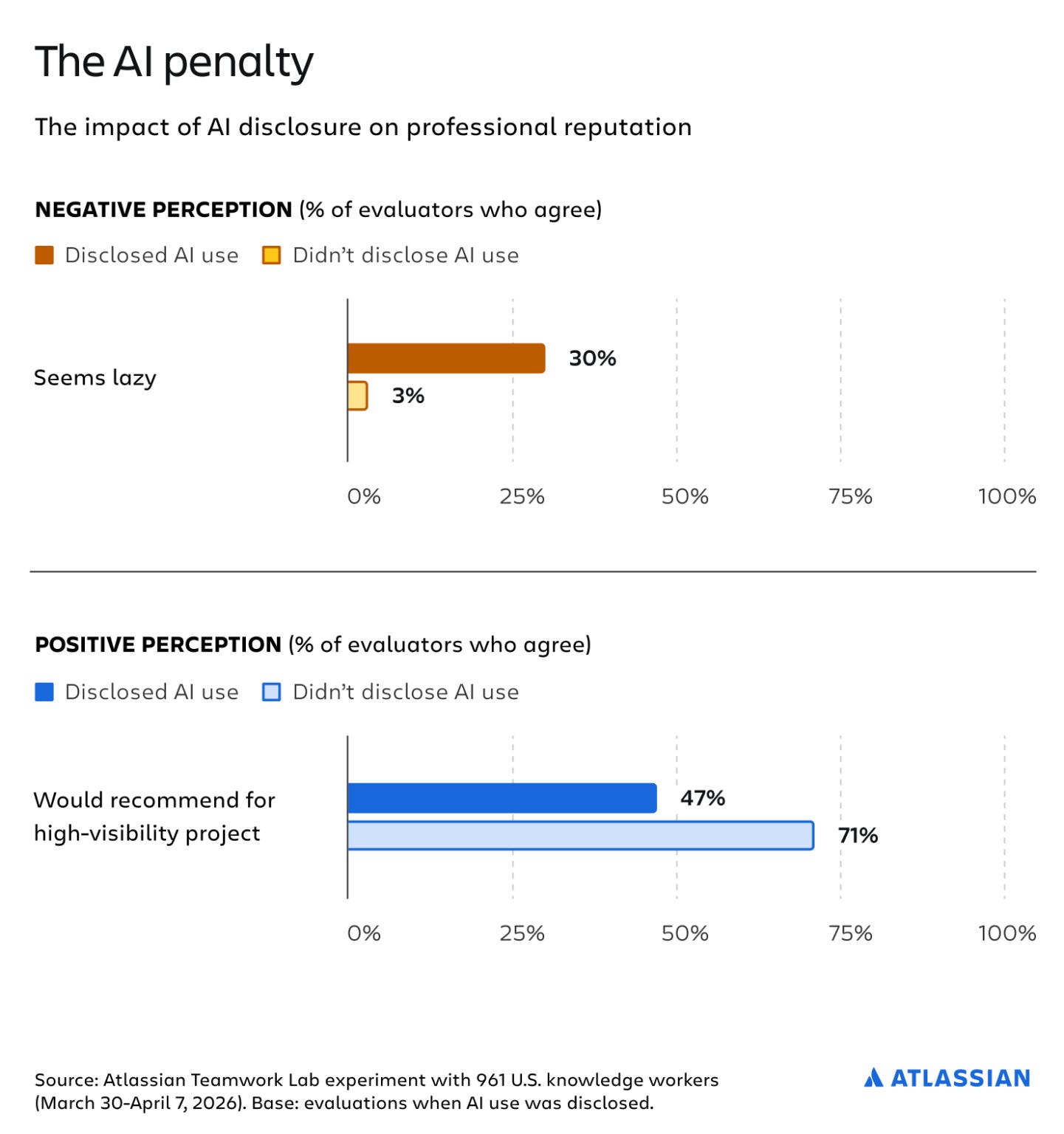
The AI penalty
Atlassian found that 94% of office workers report they used AI last month and nearly 80% are entirely transparent about their use. But there’s a price: when evaluating identical work, colleagues were 10X more likely to rate AI users as lazy (30% vs 3%) and less likely to recommend them for high-visibility projects.
Excellent piece that could serve as an effective wakeup if folks can slow down enough from pumping up profits to learn how to use AI more intelligently and humanely. I hope it wasn't discovered to go from recession to depression.
Why not let the companies do what they do best (allocate resources) and just ensure that there are policies in place to tax capital/tokens and redistribute to workers? Instead of relying on leaders to "see the bigger picture" and have empathy?