Ambition has left the chat

Something different: a shorter dispatch, new research, a couple of invitations to join me online and in-person, and a few things I’ve been reading.
Ambition
Got an email this week that summed up the moment. AI and cost, the writer explained, are now “a single agenda item” for CEOs and the Board. AI as a means to cost reduction, discipline, efficiency, expense management.
Whatever happened to ambition?
AI has the potential to transform jobs for the better. I’d like to see CEOs have real ambition about what we can build and grow, ambition to take on growth and redefine categories. Unfortunately, the tech and services industry narrative has focused on AI as a means of cost reduction. That reductionist thinking is bad for AI’s potential to transform, for employees, for the economy — and is just overall weak sauce.
Here’s hoping that the giants focused on AI as cost reduction are rapidly outpaced by their more nimble competitors who see the potential to accelerate their demise. And who will pick up some great employees along the way: Talent goes where ambition lives.
Speaking of bad ideas …
No, your AI agents don’t belong on the org chart
When I told my wife Maureen that companies are putting AI agents on the org chart and debating whether the CIO or the CHRO should “own” them, she did a spit take. Maureen is an executive coach, so it’s not like she hasn’t seen leaders with bad ideas when it comes to motivating humans.
“Treat AI like a teammate” works if you read it as “prompt it like you would an intern,” getting people to be specific in how they task generative AI. It’s very 2025. Treating an AI agent that does a group of tasks (not really a job) like a human does a lot of bad things.

Disclosure: I’m a senior advisor to BCG. With that out of the way: BCG and Boston University researchers put proof points behind the ick this week in HBR. Humanizing AI shifts accountability away from the people supervising it, increases escalations by 44%, reduces review quality by 18%, and erodes professional identity and trust.
Worse, the framing doesn’t actually move the needle on what leaders are trying to fix. Anthropomorphizing AI doesn’t meaningfully increase people’s intent to adopt it or integrate it into workflows, which is the real barrier to capturing AI’s value. The “digital employee” framing makes the technology feel less foreign and looks good in investor decks.
But it also dismisses human accountability, and widens the gap in enthusiasm between executives and the people who actually have to use this stuff:
“Employees feel enthusiastic and optimistic about AI adoption in our organization.”
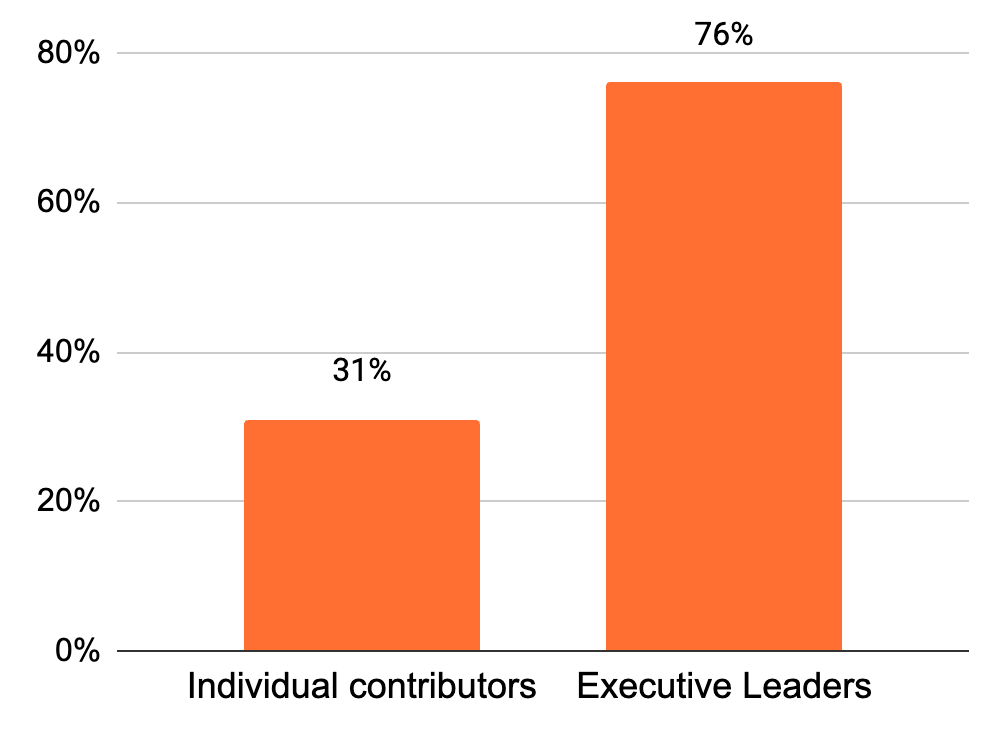
Source: BCG Henderson Institute, Columbia Business School, Oct 2025
Real progress comes from team-level integration with clear ownership and quality standards. Naming your agent “Alex” and giving it a Slack avatar is no substitute for the harder work.
Join me online
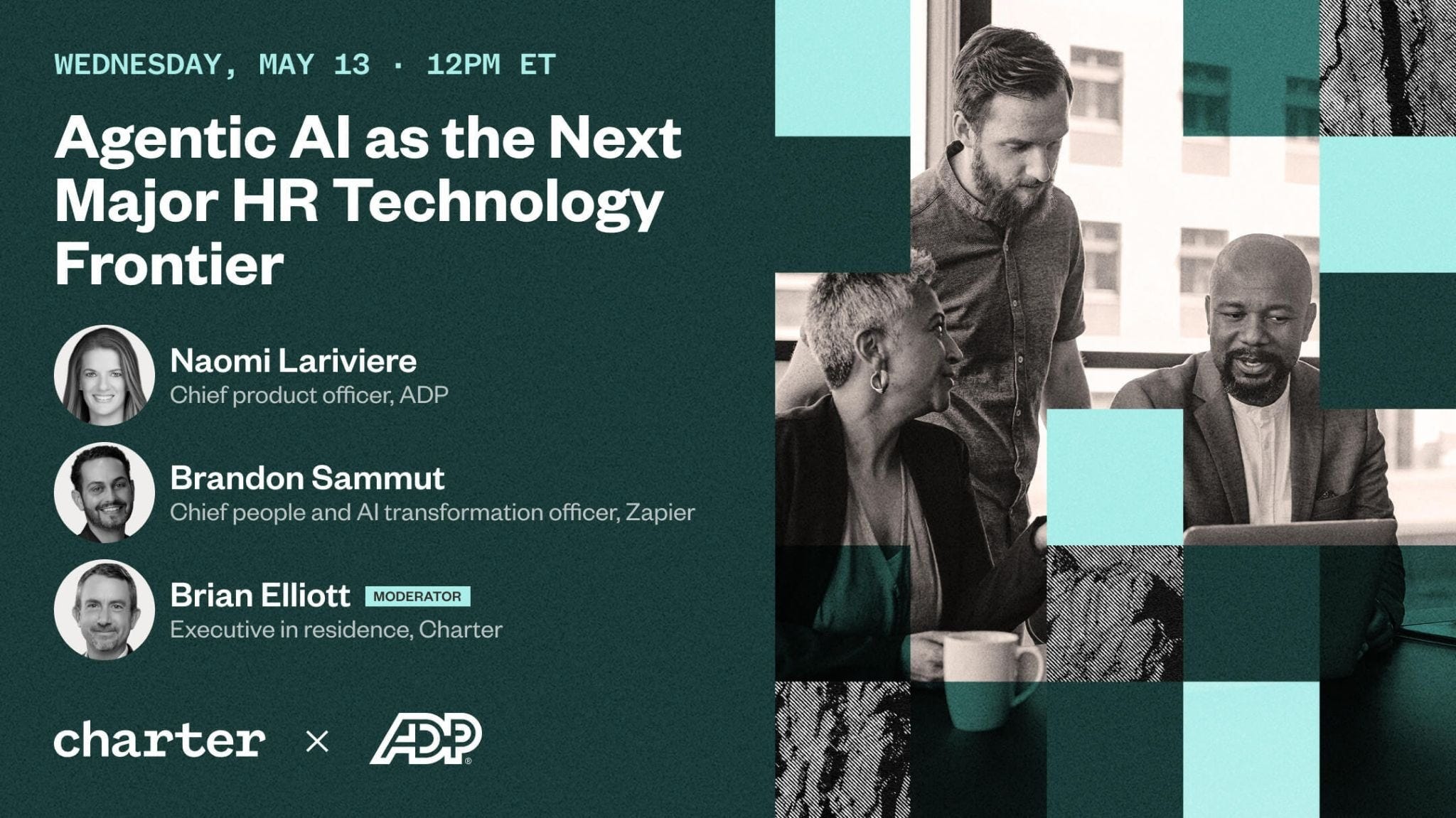
I’m moderating a Charter webinar with two leaders actually building this stuff: Naomi Lariviere, Chief Product Officer at ADP, and Brandon Sammut, Chief People and AI Transformation Officer at Zapier. The topic: “Agentic AI as the Next Major HR Technology Frontier.” Some of what I’m planning to lob at them:
Where are we today: hype vs. reality on agentic AI
Agentic AI and the disruption of HR’s silos
Should we treat agents like employees? (Um, no. Read above.)
The knowledge management challenge: our internal documentation is a train wreck
Who’s gonna pay for all this? Tokenmaxxing has a cost, and Uber’s CTO burned through his 2026 AI budget in April
Are managers going the way of the dodo bird? Can we all just “player-coach” our way forward?
Wednesday, May 13 | 12pm ET / 9am PT. It’s free. Register here.
What else I’m reading
“Culture eats strategy for breakfast” is true. It’s getting truer. If you think a slide deck and a stack of carrots and sticks drive great results, your ambition (there’s that word again) is small.
People care about their work. They want to be proud of what they do. Show trust, they’ll be accountable. Show support, they’ll help each other.
The shouty-CEO, command-and-control, replace-them-with-bots zeitgeist says the opposite. That we should stop caring.
I refuse.
I’m not alone. I see it in a lot of writers here. I hear it in workshops, at events, with peers who show up looking for the same thing. I even find it on LinkedIn occasionally (gasp).
Sometimes I find it in writing too. Read Jonathan and Melissa Nightingale:
We don’t believe that you can stop caring over the long run. No one who knows what it’s like to genuinely love their work, and the people they work with and for, and the people their work impacts — no one who feels that way finds it easy to shut it off long-term. And it is a shouty belief of ours, by the way, that you shouldn’t have to.
What’s next
Tell me what you want me to dig into. I’ve got case studies stacked up on AI transformation, sustainable leadership, manager training, building boundaries, and what makes cultures actually work. Where are your teams stuck?
p.s. Join me in person (or online), June 9
Is AI turning your workplace culture into a hellscape of 996 and “if you’re not hardcore, you can’t win”? The current tech zeitgeist says winning with AI means all speed, all in, all the time. Burn the boats. Hustle harder.
I’m seeing real changes: leaner teams, flatter organizations, rising expectations around AI fluency. I’m also seeing the consequences: velocity without direction, burnout, AI brain fry, and critical errors.
The best leaders know that great teams are built on more than speed and the hope of an equity payout. AI doesn’t fix your culture. It amplifies whatever culture you already have, good or bad.
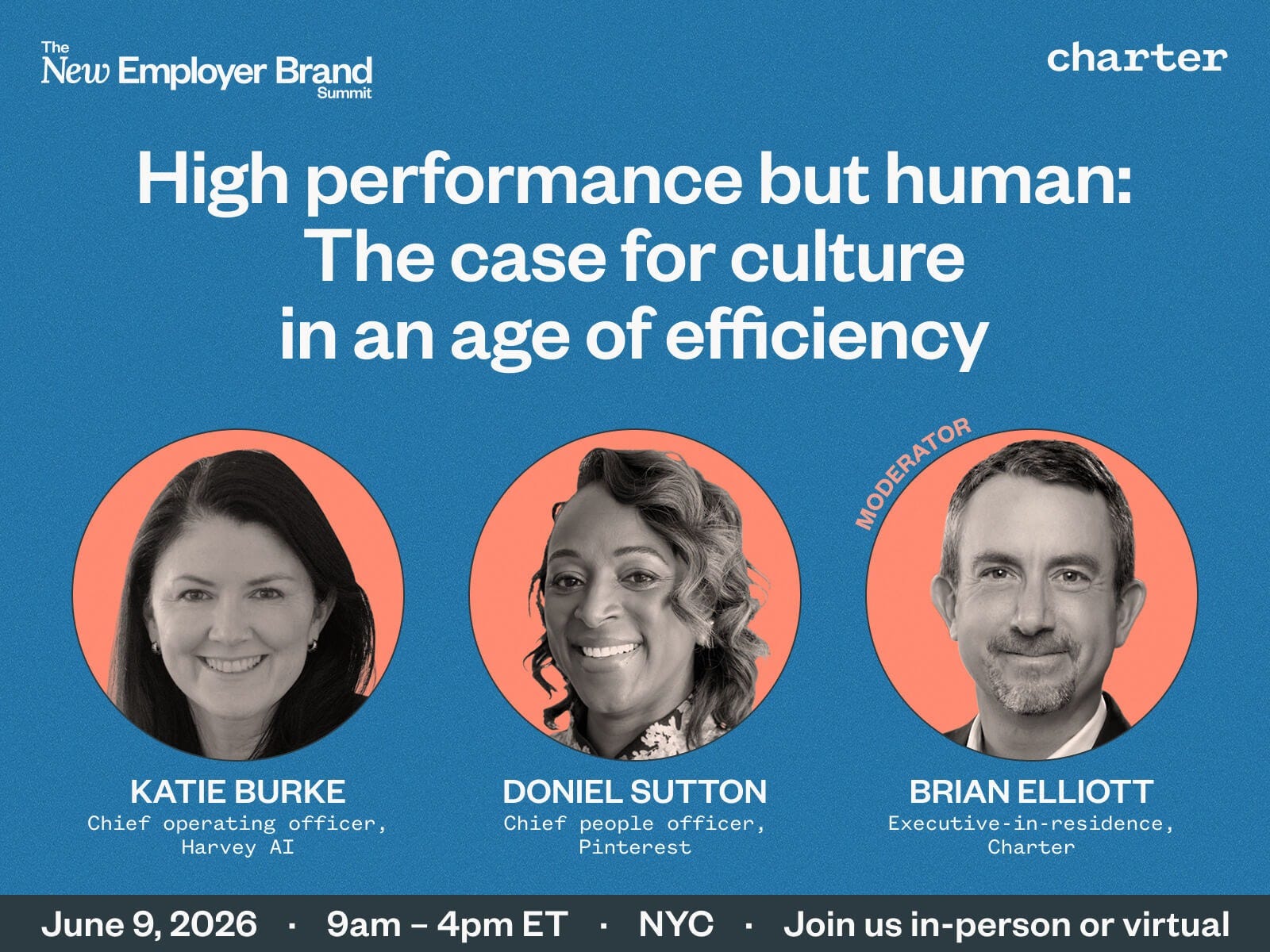
How do you design cultures, leadership, and trust in this environment? That’s what I’m digging into at Charter’s New Employer Brand Summit on June 9 with two leaders who live it: Katie Burke, COO at AI-native Harvey, and Doniel Sutton, CPO at Pinterest.
50% off in-person registration with code HALF (registration requires approval). Online registration is free.