
Your team norms probably suck
Most teams mistake logistics for alignment. Here's the difference, and what it takes to fix it.

Three-quarters of teams have never established formal norms for how they work together. No shared goals. No clarity on who makes which decisions. No agreement on how information moves. Just people figuring it out through osmosis: unwritten rules that accumulate slowly, dysfunction that hardens quietly, and a growing list of meetings that exist because no one can get answers any other way.
Meanwhile, every tech firm, consultant, and CEO is saying that AI will transform everything about how you work. Being able to articulate how you work would be a decent first step. But we usually screw that up as well.
The companies that have invested in working agreements mostly get the logistics right: office schedules, communication tools, meeting cadences.
What they skip is the harder questions underneath: why does this team exist, and are we actually working toward the same goals? Skip those, and all you’ve done is document dysfunction, but cleaned it up a touch.
Getting it right pays off. Today’s newsletter centers on a team that did the work and saw the benefits: shared understanding of goals up 2X, meetings cut in half, and meeting effectiveness up 3X. Kind of dreamy, right? Nope: just the result of putting in the hard work of aligning teams.

How team agreements really work
Team agreements go well beyond RTO policies about how many days a week you need to show up. The same work — aligning goals across functions, clarifying who makes which calls, redesigning how information flows — is exactly what organizations need to do to redesign work around AI. The team working agreement can’t just be a paperwork exercise. It needs to be organizational infrastructure: how you kick off every single project, and the foundation for functional teams.
Sacha Connor, CEO of Virtual Work Insider, has watched this play out across dozens of organizations. “I hear from companies that they use team working agreements. When I dig in, they might have put a toolkit on their intranet as a self-service option. Maybe a couple of people downloaded it. Team leaders don’t feel confident in knowing how to actually design and implement new ways of working.”
A case study from a global retailer, shared in a recent Charter Forum session, shows what happens when you stop skipping it. We’ve disguised the name of the team, but are grateful they’re letting us share what they learned!

Sacha Connor, CEO Virtual Insider
Invisible dysfunction
When the marketing organization at this retailer went through a major reorg, it created a new cross-discipline team spanning two highly interdependent sub-functions. On paper, this made sense. In practice, it was messy.
One side of the team had five people managing relationships with groups of fifteen colleagues each. That 15:1 support ratio created a bottleneck that spawned endless meetings, constant pings, and a race-to-the-top escalation culture where disagreements landed on VPs’ desks weekly instead of being resolved by the people closest to the work.
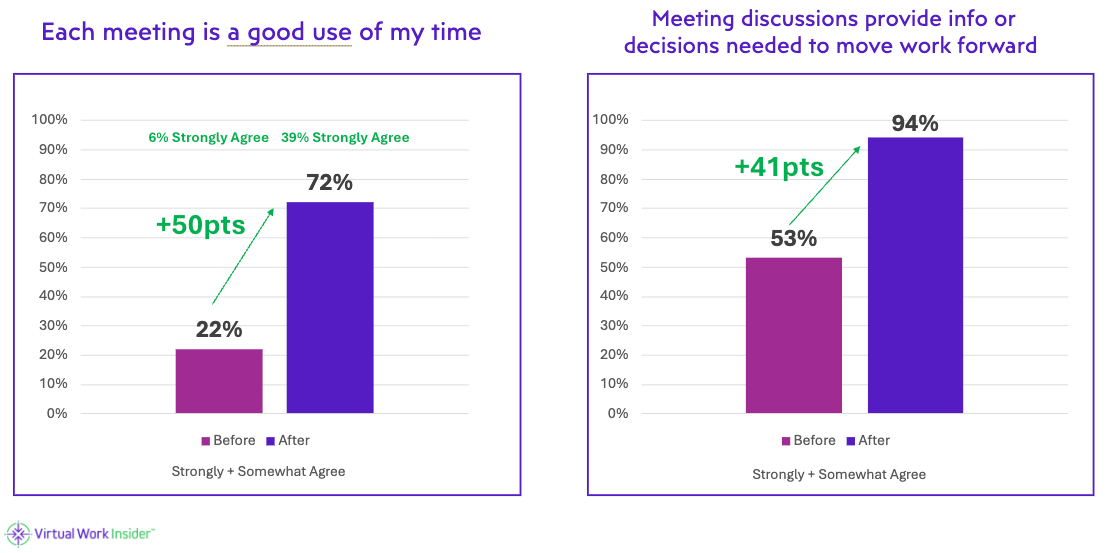
The numbers were grim: only 22% of the combined team thought meetings were a good use of time. Just 39% even understood the metrics they were being evaluated against. Only 41% felt information was flowing effectively across teams.
As I wrote in The Training Gap, only 25% of managers have received training to lead distributed teams or have established norms for how they work together. We keep asking people to navigate complex cross-functional collaboration without a roadmap, then wondering why it breaks down.
The leaders involved knew things weren’t working and brought Sacha in to help. As one director put it, “none of this was surprising.” What they didn’t have was the time, the tools, or the know-how to fix it.
Meetings are a symptom
When cross-functional teams struggle, the first instinct is usually “fix the meetings.” Sacha has heard this request dozens of times. She’s also learned that meeting overload is almost always a symptom, not the disease.
For this team, the real culprits were misaligned goals and role ambiguity. One function’s top KPI was a much lower priority for the other. As one director described it, their metrics simply weren’t aligned, and missing that goal was devastating for one side while barely registering for the other.
This is the dynamic I described in Smart Goals, Smarter Teams: Without shared goals or clarity on who can make which calls, teams default to escalation. One leader described people constantly going to “mom and dad” to mediate, instead of being empowered to work things out themselves. Without that structural clarity, more meetings get added to the calendar, because meetings are the only reliable way to corner the small group of people with answers. Fix the calendar but not the problem, and the underlying structure just fills it back up.
The actual work
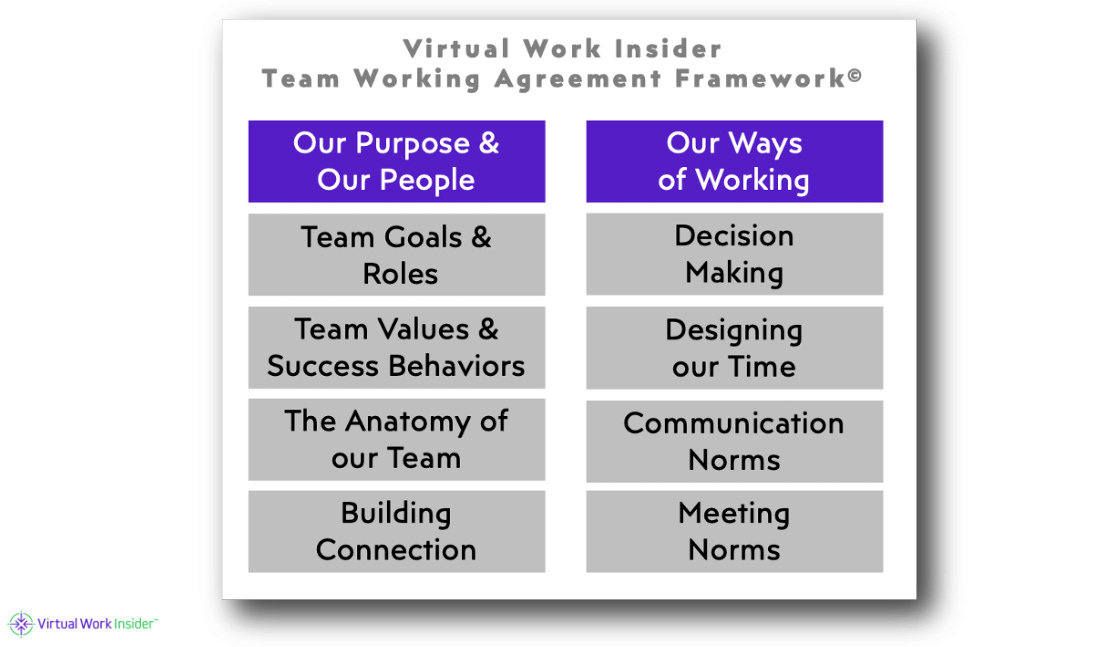
The team invested in five intensive 90-minute working sessions over two months with Sacha’s team, using the Virtual Work Insider framework that addresses purpose, roles, and ways of working as a system.
One counterintuitive move shaped the outcome before the sessions even started: the team brought its two biggest skeptics in as stakeholders rather than leaving them on the sidelines. By the end, both had become among the loudest champions of the change. It’s the same dynamic Rebecca Hinds has called the IKEA effect: when people help build something, they’re more invested in making it work. Applies to furniture. Applies to working agreements.
The process wasn’t easy. One leader admitted that if the team had known the full scope upfront, they probably wouldn’t have started. Another described some sessions as the kind of work that left her ready to shut the laptop and pour a glass of wine. But as she put it: “there’s never going to be a right time, and things were already shaken up.”
Three specific moves made the difference.
Align on goals first. They laid their KPIs side by side, identified the misalignment, and brought their VPs along gradually. One director described “seeding information along the way so that when everything was finally presented cohesively, the conversation didn’t get derailed.” They’re now building shared, word-for-word objectives into this year’s planning cycle.
Clarify roles before redesigning anything else. They created designated points of contact (one knowledgeable person per category as a clear first stop for routine questions) which absorbed the demand mismatch without adding headcount. In decision-rights terms, they defined who handles routine issues and who makes the final call on escalations, giving explicit permission to decide at the right level.
Build norms around the tools you already have. They redesigned their communication stack around Microsoft Teams channels. This sounds mundane, but most employees didn’t know what channels were, and IT had notifications turned off by default. They established the “eyeball emoji” norm: just acknowledge you’ve seen a message, even if you can’t respond yet. It worked: information flow effectiveness jumped from 41% to 83%.
I watched this pattern up close during my years at Slack. Organizations would buy the product, turn it on, and then recreate their email inbox inside it (same habits, different container) because nobody invested in norms for how the tool was supposed to work. The technology was never the intervention, the norms were.
Courtesy Virtual Work Insider
The numbers
The team achieved a 75% reduction in escalations, with months where none occurred at all. Meetings dropped by more than half. Meeting effectiveness satisfaction jumped from 22% to 72%. Shared understanding of team metrics went from 39% to 83%.
Sacha has seen these results stick. In another engagement at the same retailer, a team sustained its positive scores 18 months later. Several practices — including a “5 Ps” agenda format for meetings (Purpose, People, Process, Product, Pre-Work) — have since been folded into the company’s corporate L&D curriculum.
What you can do now
Diagnose before you prescribe. If your teams are drowning in meetings, resist the urge to start with a calendar audit. Map out staffing ratios, goal alignment, and decision-making clarity across your cross-functional teams. The meetings are almost certainly a symptom.
Invest real time in working agreements. A one-hour workshop won’t change behavior. Passing out forms is a waste of everyone’s time. Budget for multiple intensive sessions, and bring your biggest skeptics into the process as stakeholders rather than leaving them on the sidelines. Or don’t bother.
Teach people to use the tools they already have. Your organization almost certainly has async communication tools that teams barely understand. Check whether basic features like channel notifications are even enabled, and invest in hands-on training before concluding the tools don’t work.
Bring leaders along incrementally. Don’t surprise your boss with a finished proposal. Seed information over time so that when you present a cohesive plan, you’re building on conversations that have already happened — not launching a surprise attack.
Looking for more help and insight? Reach out to Sacha Connor at Sacha@virtualworkinsider.com to learn more about her Virtual Work Insider programs.
What's the biggest barrier you've hit trying to get a team aligned on goals and norms — and what actually moved the needle? I'd love to hear what's worked, and what hasn't.
Other things you should read
Leaders, silence and erasing women in the workplace
Joanne Lipman’s NYT OpEd is fantastic, scathing and infuriating read about the efforts to erase women in the workplace and beyond. An excerpt:
In a recent Harvard Business Review article, the sociologists Frank Dobbin and Alexandra Kalev identified several initiatives available to all employees that can actually be more effective than D.E.I. programs in boosting outcomes for marginalized groups. They highlighted the successes of IBM’s formal mentorship programs, Walmart’s training academy and Gap’s family-friendly scheduling options. All three companies recorded increases in the percentage of women and people of color in senior roles.
Just don’t ask IBM, Walmart or Gap to elaborate on those impressive findings. I did. All declined.
The ending is brutally honest as to why the current administration is driving fear into leaders and causing not just a pullback but silence in the face of ludicrous reversals:
When women mobilize, countries are more likely to be egalitarian democracies. That’s why authoritarians fear women. The rest of us shouldn’t.
Dear managers: the beatings will continue until your morale approves
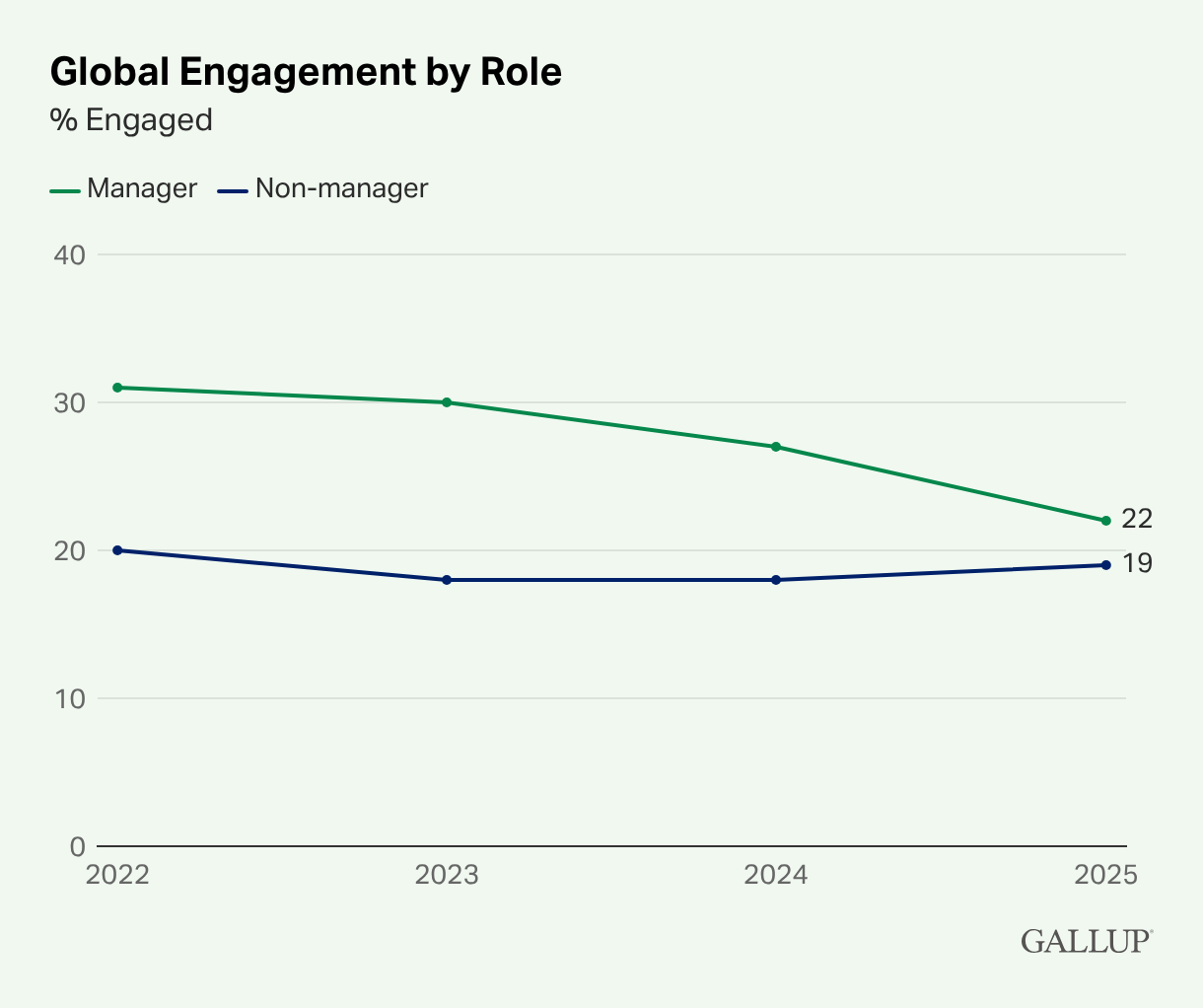
Gallup’s latest just shows how disengaged workers are. Work sucks. It’s sucking more and more for managers. Employee engagement dropped again last year, down to 20% overall. But managers took the biggest swing: down 30% over the course of the last 3 years, from 31% to 22%.
Why should bosses care? After, AI can allow us to replace managers, right?
Managers enable AI transformation. Employees who strongly agree that their manager actively supports their team’s use of AI are 8.7X more likely to strongly agree that the AI has transformed how work gets done in their organization, 7.4X more likely to strongly agree that AI gives them more opportunities to do what they do best every day.
Leaders keep whacking layers at the lower levels without changing anything about how work gets done: managers go from spans of 6-8 people to spans of 10-12, no change in bureaucracy. No time left for their own craft, let alone coaching people who are generating tons of AI workslop, or providing space for team learning and experimentation.
The ones who are left are overtaxed, undertrained and wondering when the axe is coming for them. Those are the same people that are essential to enabling true change.
Sound familiar?
Coverage of Anthropic’s Mythos Preview
The security implications are massive, as described by Thomas Friedman in the NYTimes and Platformer. Casey Newton goes deeper into Project Glasswing (the 40 companies working together to tackle security implications) the questions I’d had when reading Friedman’s piece:
“We only have something like six months before the open-weight models catch up to the foundation models in bug finding,” said [security expert Alex] Stamos, who previously led security at Facebook and Yahoo. “At which point every ransomware actor will be able to find and weaponize bugs without leaving traces for law enforcement to find (and with minimal cost).”
and Casey’s close:
A functioning government would take a strong interest in what Anthropic is up to here, if only out of self-preservation. We simply don’t know whether Project Glasswing will be enough to protect critical systems from being breached — and for how long.
Have a great rest of your week….