

The winners lose their nerve
Before dessert with Jamie Dimon, my tablemates debate how fast we're coming apart

Saturday columns are OpEds, and a bit off my usual track. Want workplace analysis? Come back Thursday. Want to hear what I’m hearing? Stay with me.
They’re today’s Masters of the Universe. They sit at the epicenter of the AI boom, in the Bay Area that JPMorgan’s Noah Wintroub said on Monday holds “35% of the world’s market capitalization.” And they’re worried.
The direction feels wrong in every dimension. Leadership is weak. Entry-level workers are drowning. The chaos outside has moved inside, into every meeting and every day, and “uncertainty” has become a faucet no one can shut off. You’d assume I’m describing the employees who pushed confidence to an all-time low in July.
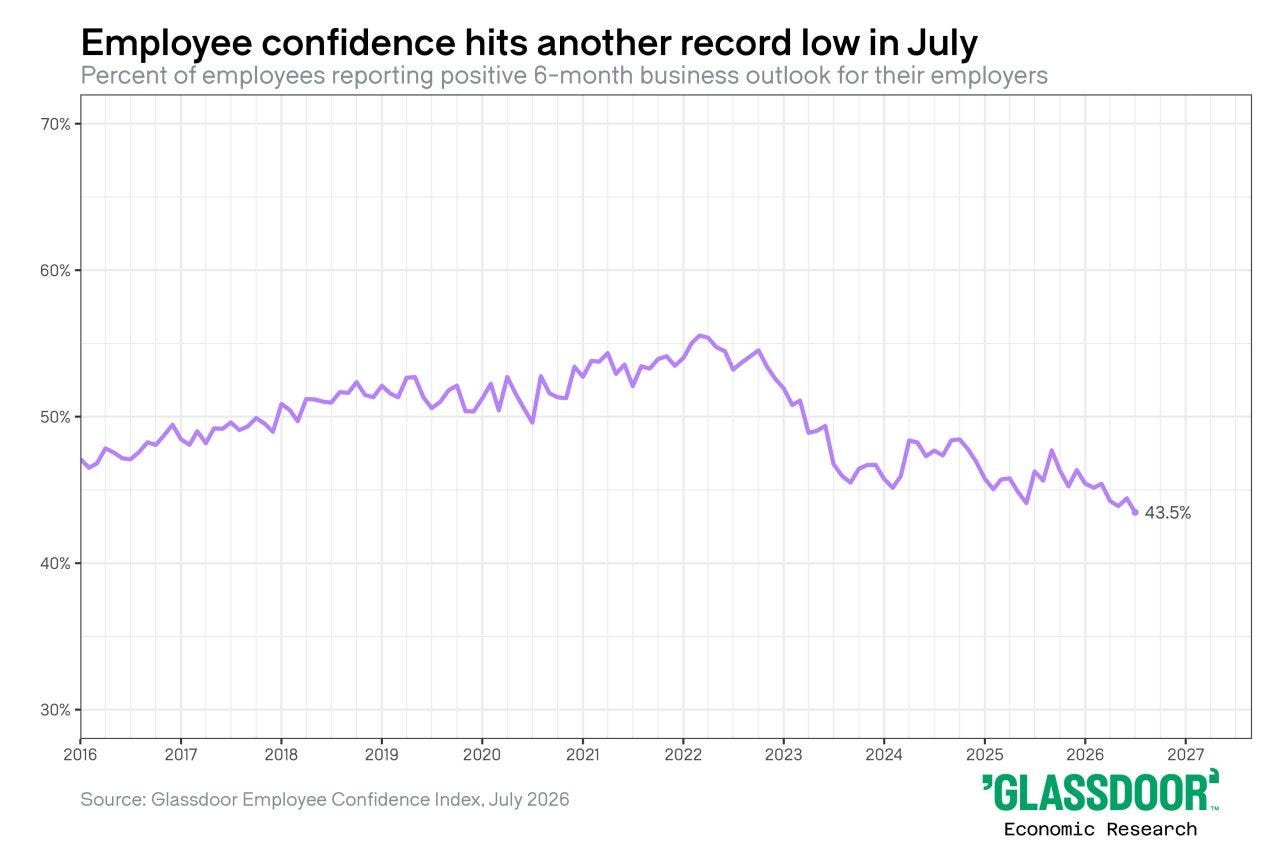
Source: Glassdoor, July 2026
Nope. I’m talking about the people at the top. The ones who in late ‘80s Bonfire of the Vanities mode would have owned the next decade, who now feel the floor tilting, and whose faith in institutions just tied its own record low. The winners are losing their belief in the system that got them near the top.
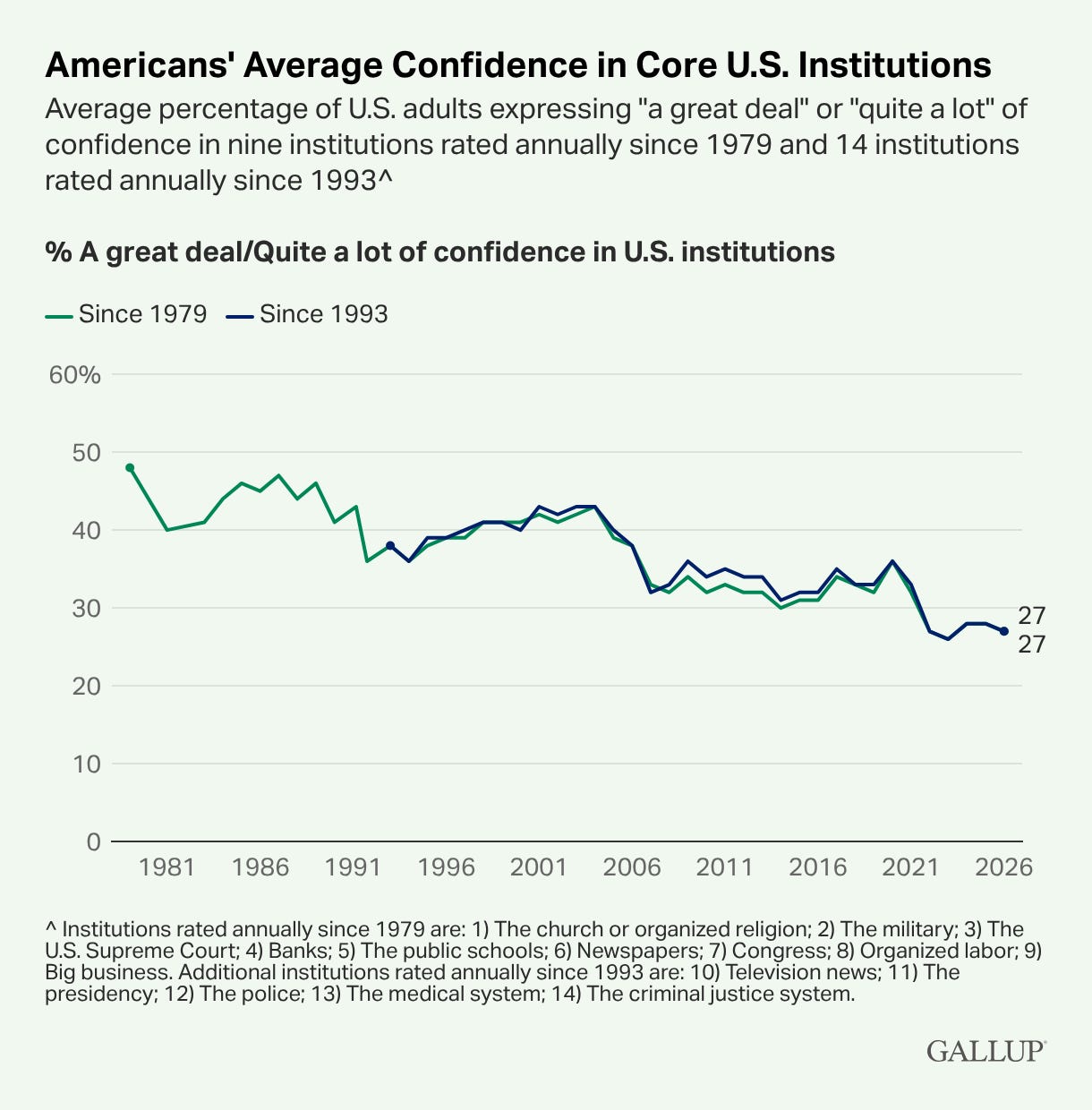
Source: Gallup, August 2026
I’ve had a version of this conversation several times now, surprisingly with people I’ve just met. Over a meal, around a table: public-company C-suite, big commercial real estate owners, PE investors, long-tenured tech leaders. Mostly in the Bay Area, but definitely not exclusively. The topic, every time: WTAF are we doing to this country, and how fast do the pitchforks come out? Perhaps more fundamentally, what are we leaving for our kids?
It’s not the conversation you see online, which is either muted and commercial (LinkedIn) or engineered to farm your rage (everywhere else). This is real, emotional, and startlingly open: rich people who think the country has lost its way and can’t find the map.
Dessert with Dimon
The latest one happened at an SF Standard event where the dessert course was an on-stage conversation with JPMorgan Chairman and CEO Jamie Dimon. With all due respect to the excellent moderators, the best content of the day was at my table.
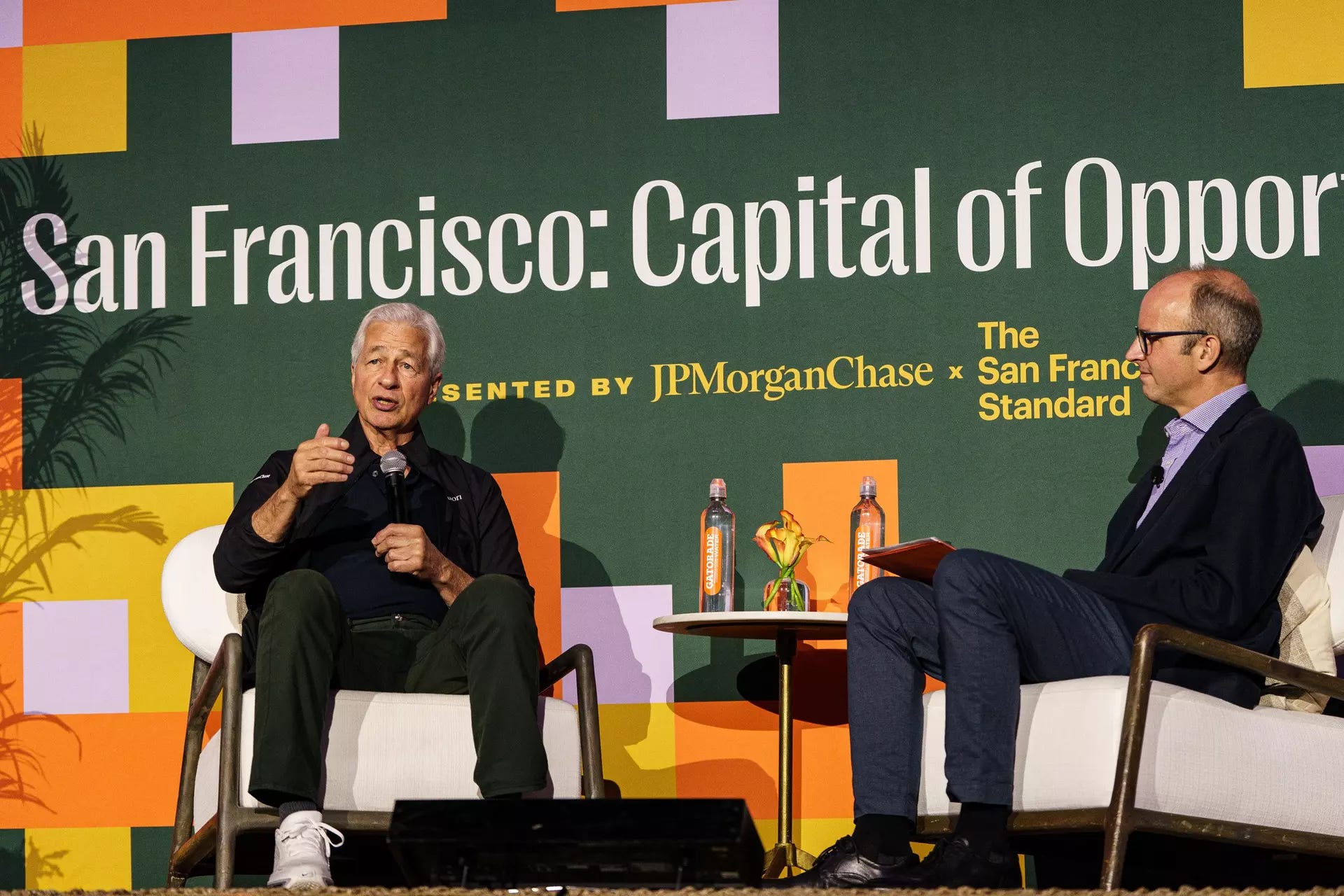
Source: The San Francisco Standard; my seats weren’t this close.
My tablemates reflected similar groups that I’ve had this conversation with this year in various cities at various professional events. In the Bay Area, they range from moderate-liberal former tech execs to moderate-conservative real estate investors. Modest diversity, of the rich-Bay-Area sort: a couple of women, two non-white people, the rest of us stale, pale males.
I blame a real estate guy for starting it. “What do you think we should do about... this?” This being income disparity, polarization, and the sense the country is driving the wrong way with the gas pedal stuck.
How much is enough?
I asked for his answer first, then stuck my neck out: “Tax the rich.” I meant a workable federal wealth tax, which I can’t design because I don’t know a thing about the tax code, though I do know the California-only, one-union ballot version is a mess. Dimon’s take from the stage: any wealth tax would get so complex it would “create millions of jobs,” for the lawyers, compliance officers, and appraisers hired to fight it. He circled back, more than once, to something something “capital formation,” implying risk to future investments. Many European countries have, as Dimon points out, rolled wealth taxes back.
The table wasn’t buying it. They agreed the tax code is failing us, that a country that created a trillionaire (in one tablemate’s words, “one of the worst humans ever”) while people go hungry is absurdly screwed up. The liberal end introduced me to the Patriotic Millionaires, who are keen to tax themselves right alongside the billionaires. That opened the lunchtime parlor game: why would anyone ever need more than $30M? Park it, and it throws off a cool $1M a year in walking-around cash, forever, without you lifting a finger. One holdout raised the floor to $100M.
What everyone did agree on, without quite meaning to, is that too many people now fly private, keep staff, and never brush up against a normal human day. Somewhere the Excessive Wealth Disorder Institute is nodding (and yes, that is the actual name).
Gas on the pitchforks
Where the table aligned was narrower and sharper.
Housing, over and over, and it came up all day: pretty much everyone landed on it before Dimon did, and nobody thinks it’s just a NIMBY problem. It’s the well-meaning rules that choke supply too (cue Ezra Klein‘s Abundance).
On wages, even the conservatives sounded like Scott Galloway fans: a living wage shouldn’t be an aspiration, it should be the floor. Dimon later pointed out that “wages haven't gone up for 20 years” for the bottom 20%.
Nobody had much energy for UBI, and nobody could quite sketch how universal basic capital would work. But Ben Walter, who runs one of JPMorgan’s many businesses with “CEO” in the title, made a point that stuck: ownership changes how people show up for a company, the culture, the sense of a stake. So why not for a country? Nobody at the table had a good reason it couldn’t.
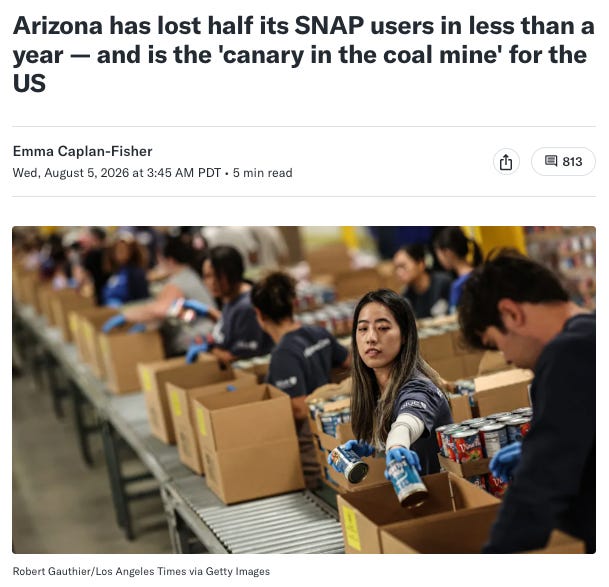
And where w’re cutting? Funding tax cuts by cutting food assistance, enough to knock more than half of SNAP recipients off the rolls in Arizona, is pouring gas on the pitchforks. I grew up needing food stamps. The people doing this can fuck right off.
Everyone was sweating jobs. From the stage, Dimon told the room not to “hypervent” about AI killing jobs: more created than destroyed, he figured, skating past the churn in the middle. My table wasn’t convinced. They’ve sat in too many cost-cutting meetings, in a region where 2026 tech layoffs have already passed all of 2025.
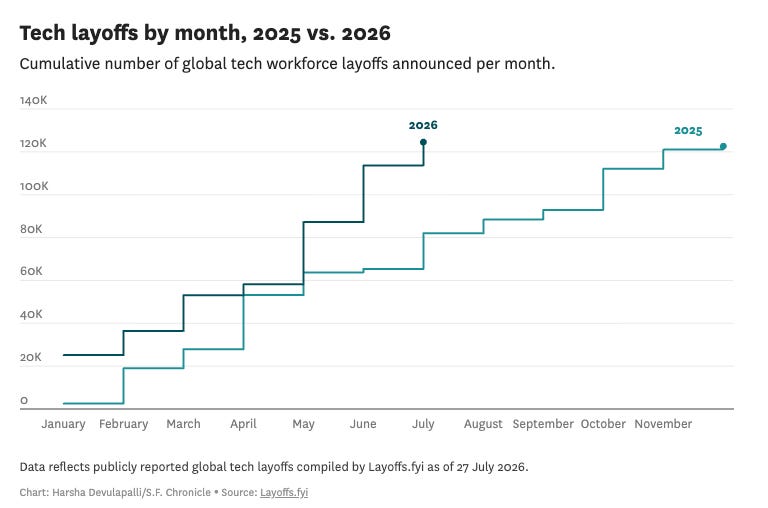
Source: SF Chronicle, Layoffs.fyi
Nearly all of them are parents of Gen Z kids who, even when they’re fine themselves, have friends who aren’t. “One of them accepted two offers. I asked why. She said, ‘I’m sure at least one will rescind anyway, it keeps happening to us.’” The trust one company burns, everyone else pays for.
Nobody trusts the machine
The trust is gone. In politics, in politicians, in the machine itself. There was real sympathy for why the Democratic Socialists of America are gaining ground, and just as much fear that they hand seats back to far-right extremists. Everyone felt the same trap: gerrymandering has rigged the map so we lurch from pole to pole, with no room left in the middle.
After lunch, Dimon circled back to all of it, thanks to Kevin Delaney asking about reports that instead of running for president he wants to start a media company. Jamie never quite denied it, but got deeper into wanting a think-tank approach to policy, “thoughtful stuff a bunch of us nerds would be really interested to know.” It would be fun to nerd out with Jamie Dimon, though as a card-carrying nerd I’d need to see his membership.
So why write this? Because it keeps happening, with strangers, again and again. People who made real money: PE partners, VCs, techies, consultants. The monied professional class, the ones who'd glance at a human-centered leadership agenda and think "not for me," now squarely in WTF mode. Widening inequality, open corruption, systems buckling, politics coarsening, and an economy they fear won't just fail the next generation but all of us.
Please, god, Brian: what do we do?
I’ve clearly ranted enough. Your turn.
Find your voice. Not everyone can speak up. If you hold any power, start using it, out loud, where you can: on food security, housing, healthcare, and a political system that’s badly broken. Support people willing to push for solutions with time, money and your voice.
Act within your sphere. Set the tone in your own shop for what’s acceptable, starting with treating people decently and taking trust seriously. One tablemate gets called a “difficult woman” for speaking up the way a man would. We need more difficult men, too, on basic respect and the parts of leadership that don’t show up on the P&L.
Lend a hand. The Bay Area is minting new money, and a lot of it is flowing into pro- and anti-AI-regulation campaigns. Lovely, good topic. Maybe also fund your local food bank, housing expansion, or jobs nonprofit? The food-security nonprofit I sit on the board of has basically limitless demand for help. Spend the DAF.
What would you add?

Good article, and yes - we all have a voice, but amidst this chaos, are we talking about the core of the problem? Where is the control coming from? And who benefits the most from our chaos?
The pitchforks came on Jan 6. History will look back and say this was just the first act. Thanks Brian as always for saying what no one is saying out loud.