

The money changes its mind
A busted PE deal, Airtable's fire sale, and what both should teach you about what happens when financial tides shift

I. The debt must be serviced
Back in the dotcom bust, I was one of the survivors who kept a struggling ecommerce retailer called Alibris alive. We were fortunate: the company had raised a fair amount of cash just before the implosion of 2000, right after Barron’s famously declared Amazon dead.
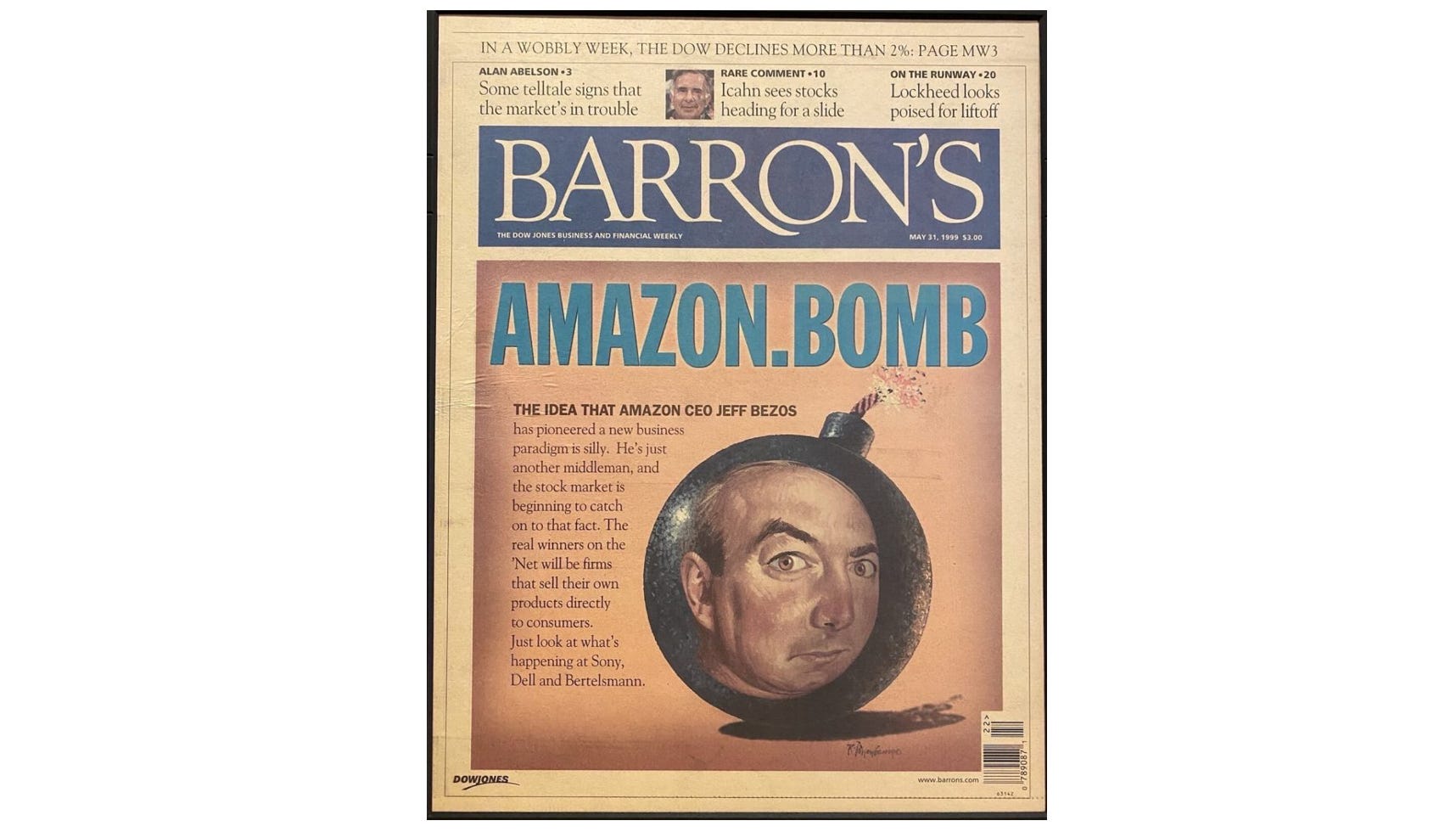
Source: Barron’s, 1999
We sold to private equity in a deal that should have paid out almost nothing. But a board set-aside, and a management team that wanted everyone to share in what little spoils there were (thanks, Marty, Mariah, and Steve), meant we all got a little something. We talked about printing “I’m a thousandaire” t-shirts.
I ended up as CEO. We acquired a couple of related firms and, tada, became our own mini-conglomerate, trying to build a SaaS company off the bones of an ecommerce marketplace back when SaaS was still in diapers.
By 2010 we had some lovely debt on the books. No worries: the legacy ecommerce business threw off plenty of cash to cover the bills, margins were growing, and we could redirect the rest into the new SaaS business. Right?
Wrong. We were selling books, music, and movies online, exactly as those things went digital. And a lot of our revenue came from supplying businesses that were themselves ceasing to be businesses. (Anyone remember Borders? Tower Records?) Cash became king, queen, and court jester. We got an education in collecting pennies on the dollar out of bankruptcy proceedings in the US, the UK, and Australia.
But the money had needs. Debt must be serviced, covenants untripped. That left three acceptable outcomes, as defined by the people who owned us: sell off a piece for a handsome sum and pour the proceeds into the growth business, sell the whole thing for a very handsome sum, or cut costs to the bone.
The very handsome sum was not a number anyone would pay. But selling below it meant a markdown, and the firm was in the middle of raising its next fund, and a markdown mid-raise is a conversation nobody wants to have with their LPs.
So we ran a process to sell a declining asset at a price set by the money’s fundraising constraint. Nobody paid it, of course. Which left the inevitable: cuts, to service the debt. That was the first time I laid myself off, but not the last.
I flew to each of our three offices to deliver the news in person. By the third city I was done on every level: physically, emotionally, and, I feared, career-wise.
I own a big share of how all of that went. I could have pushed harder to move resources out of the legacy business and into the next one, cut heads faster, or gotten any of a hundred other calls right that I got wrong. But it took me a while, once it was behind me, to see the thing for what it was. The box canyon we were driving into wasn’t walled in by our decisions. It was walled in by what the money needed.
In 2025 and 2026, a lot of SaaS leaders joined me in that canyon. What happened to one holding company in the 2010s is now the whole asset class at once. As of June 30, private equity firms were sitting on 33,575 companies they can’t sell, per PitchBook, up from 15,923 a decade ago. Same logic mine was sold on: buy it, add debt, improve margins, flip it in five to seven years. The flipping stopped, but the debt still has needs.
The returns show why buyers stayed home. From mid-2022 through this March, U.S. private equity returned 6.4% a year, per MSCI, against 15.2% for the S&P 500. Premium fees, half the market, a five-year lockup. Apollo just called its stalled exits “prudently delayed.” Maybe this whole SaaSpocalypse blows over. Maybe.
II. The deal of the (SaaS) apocalypse
Last week Bending Spoons, the Italian software conglomerate that IPO’d on Nasdaq in July, agreed to buy Airtable for $1.285 billion. Airtable raised more than $1.4 billion over its life and was worth $11 billion in 2021, so the price for the business itself is roughly a tenth of the peak. Shareholders collect about $2.25 billion in all, a fifth of the peak, once you add back the $965 million of cash still sitting on Airtable’s balance sheet. Fortune called it a $9 billion discount. And almost half of what shareholders get back is money they put in themselves.
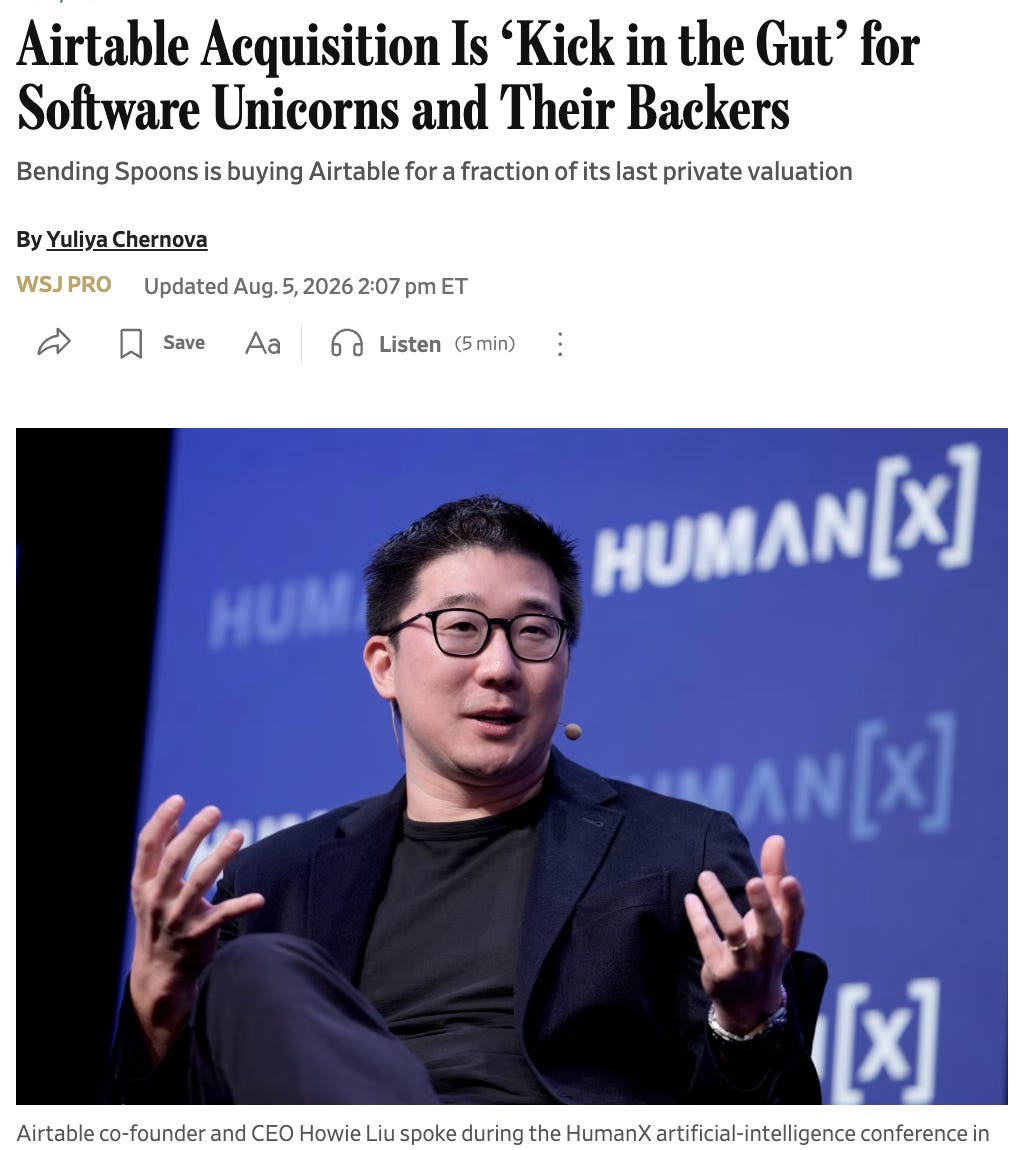
Source: WSJ
This is not a broken business. Airtable was running about $480 million in revenue as of June, growing north of 20%, with 80% of the Fortune 100 as customers. And its core, stitching together messy workflows and unstructured data, sits right in the sweet spot of AI. It sold for 2.7x revenue anyway.
Everyone filed this under SaaSpocalypse. Maybe, but I’d call it the most rational exit available. Right before signing, Airtable carved its agentic AI product, Hyperagent, out into a separate company. Bending Spoons is buying the database, the workflows, the half-million customers, and the cash. It is not buying the AI bet. Howie Liu, Airtable’s founder, keeps that and runs it next. The mature business goes to an operator who specializes in mature businesses, the cash goes back to investors who need it recycled, and the upside walks out clean on a fresh cap table.
AKA, they did in 2026 what I couldn’t in the 2010s: put the pieces where they belonged and funded a growth business.
That said, employees sitting on common stock under $1.4 billion of liquidation preferences are not having Howie Liu’s week. Controlling your destiny is a real achievement. It’s also, very often, the thing the people at the top achieve for themselves first.
III. Who actually gets paid
This isn’t only a SaaS story. Look at AI, where the checks are massive and the story is supposed to be nothing but up. The splashiest AI “exits” have run one play: a giant licenses the tech, hires the founders and a few top researchers, and the startup keeps its name and most of its staff and becomes a shell. The founders get generational money and a corner office at Microsoft or Google. Everyone else is left running the shell, and updating their LinkedIn.
Microsoft did it, paying Inflection AI $650 million in 2024 to license its models and hire Mustafa Suleyman and much of his team. Google paid roughly $2.5 billion to bring Character.AI’s founders home, cashed out the investors, and left about 100 employees at a company that then gave up building its own models. Meta took 49 percent of Scale AI, moved in its founder, and laid off roughly 200 people soon after.
Then there’s Windsurf. Last July, Google paid $2.4 billion to license the coding startup and hire its CEO and cofounders into DeepMind. Around 250 employees stayed behind holding equity that had just been vaporized, days after an OpenAI acquisition collapsed. The interim CEO described the room: “Some people were upset about financial outcomes or colleagues leaving. A few were in tears.”
Vinod Khosla didn’t dress it up: founders “leaving their teams behind and not even sharing the proceeds.” Those employees got a reprieve only because a second buyer, Cognition, waived the vesting cliffs so everyone shared. That was a choice, and it wasn’t the default.
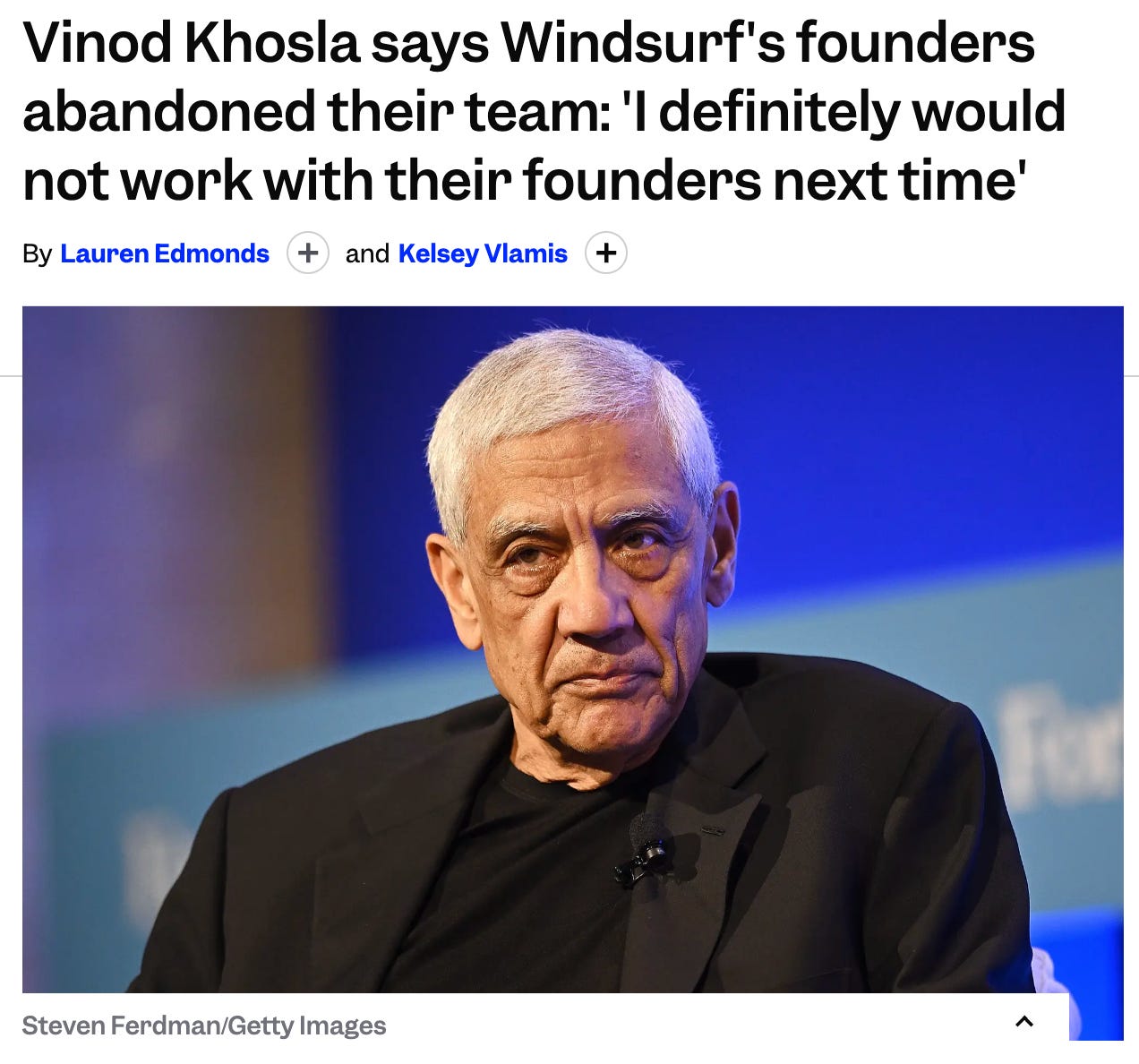
Source: Business Insider
None of these founders are villains; no one is in their own story. They had a life-changing offer and a board pushing to take it. The structure rewards the top of the stack. What it burns to zero is the trust your best people had in leaders who told them they were all in this together while running 12 hours a day, six days a week.
IV. The money changes its mind
If your company is funded by anyone, venture, growth equity, private equity, a friendly billionaire, take one thing from these stories. The money will change its mind.
Your investors don’t have to be bad people for this to hurt you. The fund has a limited lifespan, the banks have terms, the next raise needs a narrative, and none of that is your business. Even the friendly billionaire changes his tune. In 2021 SaaS was the thesis at 40 times revenue; in 2026 it’s a value asset and the thesis is agents. It will change again, faster than last time. Three things give you something to hold onto when it does.
Control the business at the ownership level, not just the org chart. Eric Ries’s new book Incorruptible is the best thing I’ve read on this. His term is “financial gravity,” the pull that drags companies off their purpose as a structural inevitability, not a failure of character. The fix is governance you build before you’re successful, because success is what attracts the pressure.
Get profitable as early as you can. Profitability is what lets you say no. Every month you can fund yourself is a month the fund’s clock isn’t yours. Airtable had that leverage, my little conglomerate did not.
Know where your people sit in the stack, and tell them the truth about it. If they’re holding common under a mountain of preferences, they’re further from a payout than your all-hands slides imply, and they’ll learn it at the worst moment. The founders who keep their reputations are the ones who level with their teams early, and share the proceeds when they don’t have to.
It’s the same question I keep coming back to, whether it’s a PE markdown, an AI acquihire, or a CEO ordering everyone back to the office to justify a lease. What happens when the money changes its mind?
ICYMI
Welcome to the ‘machine pace’ of work. Maybe the best column I’ve written on the impact of AI on people at work to date, thanks to a whole lot of research and on-background conversations with some very burned-out people. In Charter and TIME.
Like Work Forward?
Please like ❤️, subscribe 📨, and share 🔄 — it’s always free!
A very insightful read, thanks!
Nicely done, Brian. It taught me a lot, and not for the first time. Thanks.