
The Missing Leg of Employee Experience
Why Chief Work Officers need to blend people, technology and place

Here’s a scene that should trouble every CFO: A panel of senior workplace leaders from MasterCard, PepsiCo, and BlackRock couldn’t name a single employee experience initiative tied to a business outcome. Not one. At least not without warning. The moderator, seeing the awkward silence, tried to offer an out. Phil Kirschner, the workplace strategist who’d posed the question, declined: “I think the silence is deafening.”
That silence reveals a problem that’s costing organizations millions in wasted real estate spend and missed opportunities to actually improve how work gets done.
I’ve been tracking this issue for years, but a recent Charter Forum session with Phil crystallized something I’ve been seeing repeatedly: too often, real estate and workplace teams are excluded from the conversations that define employee experience. And when they’re left out, everyone loses.

Phil Kirshner
Missed: the “Chief of Work” opportunity
The rise of the “Chief Work Officer” conversation burst into public consciousness with Tracey Franklin at Moderna, focused on how humans and AI will work together by bringing together HR and IT. But Phil calls out the broader need: the ideal organizational structure of a Chief of Work: HR, IT, and Real Estate working together on employee experience. Moderna made headlines merging HR and IT under one executive. Great start. But they left out real estate.

This keeps happening. Real estate almost never gets mentioned in future-of-work reports or CHRO conferences. Leaders report up to the CFO, CPO or COO—and get shifted every few years. As Phil put it: “Workplace leaders are never in the same place twice. It’s a terminal position almost always. They are the last in line to get technical resources.”
That’s not just bad for real estate professionals—it’s bad for organizations. Most of the leaders in our Forum group have tight ties between Workplace and HR, if not direct reporting. That allows them to align policies, portfolio strategies and measurement—and avoid being stuck in workplaces that don’t work.
A simple example: when one Forum participant analyzed engagement survey data by location, they discovered their New York office scored dramatically lower on “vibrancy” than other sites. The culprit? An office that was too large and disconnected. They moved to a smaller, more intimate WeWork space.
That kind of insight only happens when workplace strategy connects to people strategy. And it’s still the exception, not the rule.
Disconnected from data
Most workplace leaders can’t connect their initiatives to business outcomes because the data they need lives in different silos. Real estate has utilization metrics. HR controls engagement and retention data. Finance owns business performance numbers. Getting all three to talk to each other? Nearly impossible in most organizations.
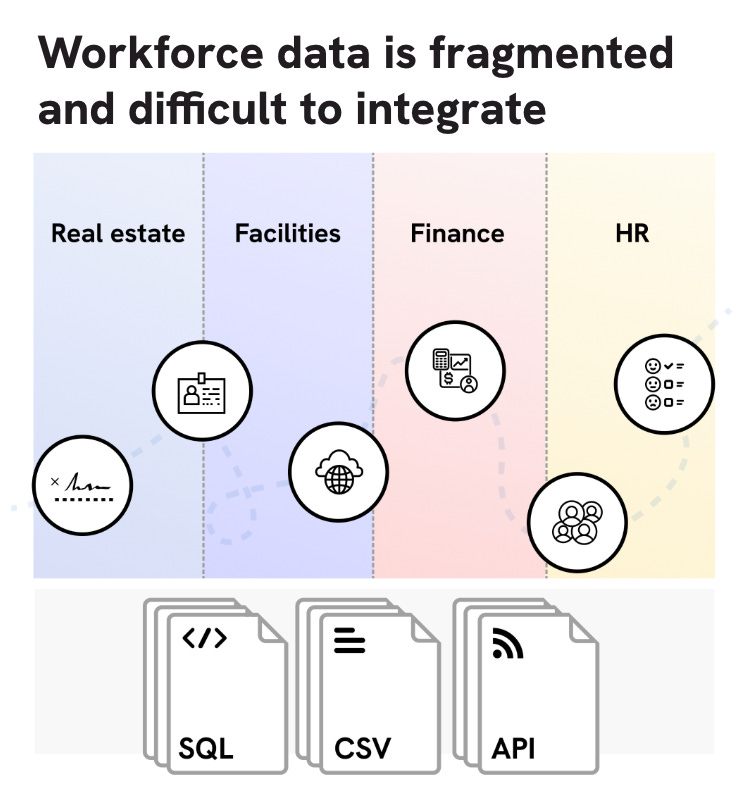
I’ve worked with companies who tried to crack this. The question seems simple: Does time in the office improve sales performance? Customer support quality? Engineering output? Link badge swipes with business metrics and you should have some indication (note: correlation isn’t causality)..
Except you don’t. I’ve seen firms with positive correlations for junior salespeople (though the real driver is usually better training and management support, not the office itself). Others find no correlation, or even negative ones. The data is splintered, error-filled, and almost never analyzed together.
Even companies with massive AI investments aren’t using them to answer these questions. At a recent event, someone asked a Big Tech workplace head whether they’d used their company’s AI tools to analyze whether their RTO mandate improved performance. The answer? No.
Why not? Because solving for internal employee experience—investing in understanding what drives outcomes—wasn’t a big enough priority to muster the resources. Sad, but true: companies invest massive amounts of effort into understanding customer experience, and think of employee experience as a chain of HR silos and policies.
So what’s actually driving return-to-office decisions? CEO vibes. Jamie Dimon doesn’t want people “Zooming in from their basement.” That’s not data-driven strategy—that’s aesthetics and anecdata

.Coworkers, not in a basement
Challenged to experiment
What worried me more was when Phil reported that experimentation with workplace initiatives has dropped sharply. Phil’s research found that workplace leaders’ capacity to “test and measure” went from second-to-last in capabilities two years ago to net disagreement territory today. That’s moving in exactly the wrong direction.
Part of the problem is mindset. Real estate teams think “experiment” means capital investment. But you can test plenty without capital: different event formats, modified space usage, varied work schedules. Allstate uses simple “happy or not” kiosks for weekly feedback by location. That’s not expensive—it’s smart.
It’s also possible to apply learning models to physical layouts. Take PagerDuty’s journey: they learned from downsizing and redesigning in Toronto, then leveraged those learnings to change their approach in Lisbon, and from there to Atlanta and beyond. Similarly, Atlassian built modular spaces in Austin designed for “Intentional Togetherness” where they can continually learn and adjust.
The key insight? These companies shifted from facilities management to facilitation of experiences. They’re measuring what matters—not square footage, but outcomes like Atlassian’s innovative “cost-per-visit” metric that Phil highlighted in his Workline newsletter, which tracks the true value employees get from coming to the office.
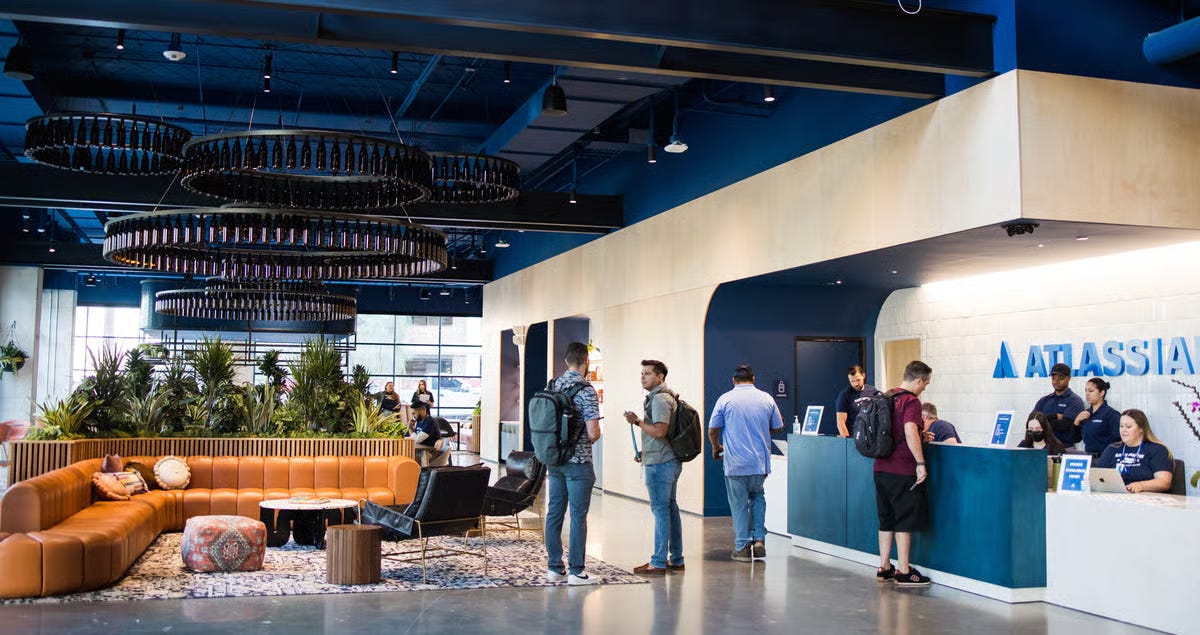
Atlassian’s Austin office
Fixed mindsets limit vibrancy
Vibrancy in the workplace matters. We all know the stories of people coming back and finding a dead-quiet space when they showed up to gain some social connection. There are simple answers: do more with less. Close 3 of the 5 floors in a 20% utilized building.
Want to know what’s blocking workplace vibrancy? Assigned desks. They’re incompatible with project-based teams, skills-based resourcing, and flexible work arrangements. Yet organizations treat them as sacred.
One participant in the conversation described moving to a beautiful new office with library spaces, sunlit areas, and flexible seating. The response? Panic over losing assigned desks—before employees have even seen the new space. As one leader put it: “It’s like this archaic way of thinking. I need my seat. It’s like grade school.”
The technology exists to solve this, and dynamic seating is only going to become more important as more office work shifts into project-oriented teams that get recomposed a few times a year. Phil described how one company using this approach went from 10 departments to nearly 200 “teams”—employees were self-organizing around running groups and other affinities, then using the algorithm to work together
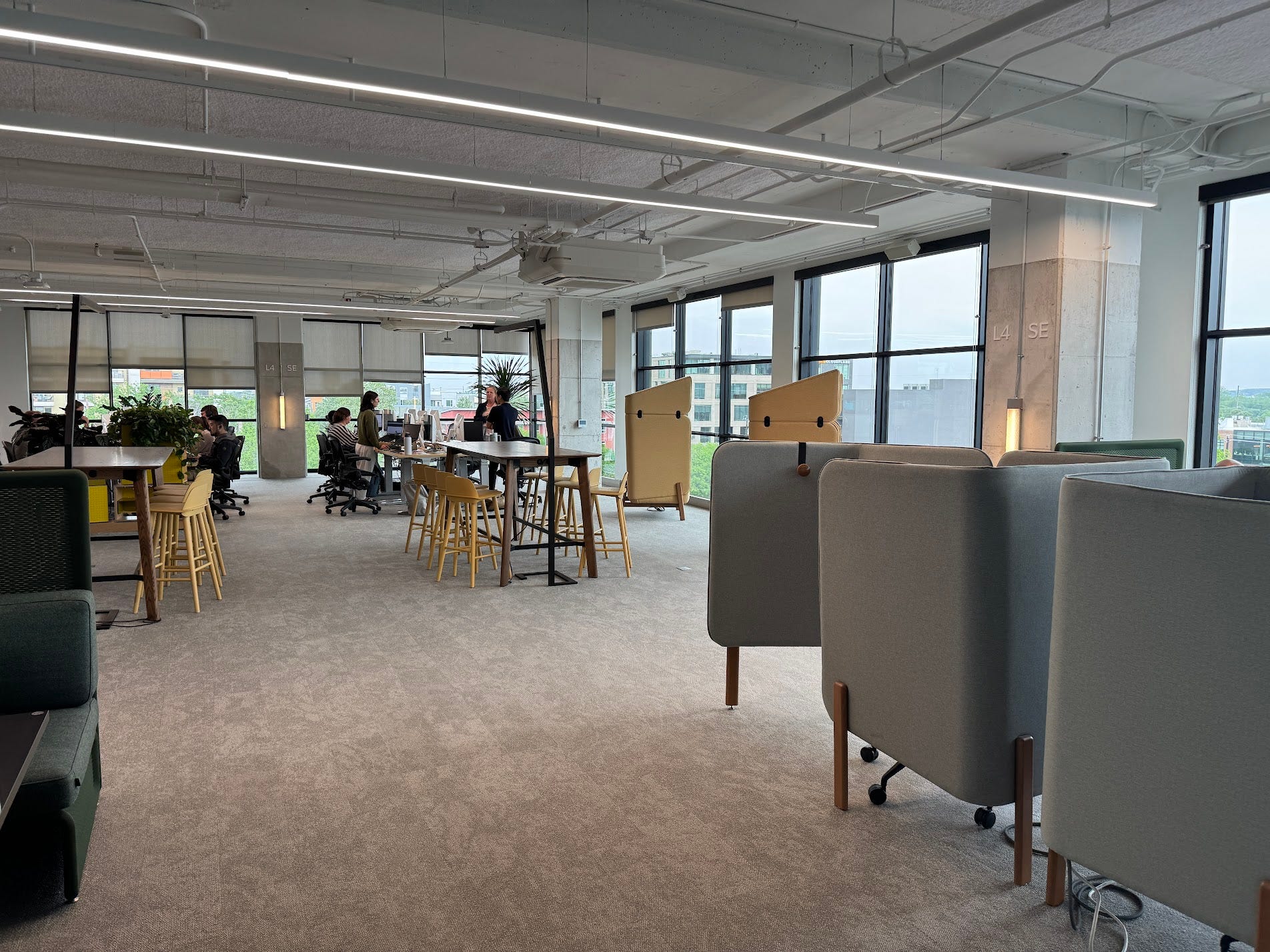
Atlassian’s highly modular Austin office
What alignment brings
The organizations getting this right share three things:
First, they put real estate in the people function. At Atlassian, Dropbox, Zillow and others who are leading the way, workplace reports to their CPOs, though they acknowledge the CFO relationship around large investments remains necessary.
Second, they measure what matters. Not utilization or cost per square foot but instead cost per visit and marrying up retention and engagement data. Outcome metrics, not input metrics. Phil’s North Star vision framework provides a solid approach here: organizations need clear, compelling visions with measurable principles and desired outcomes that drive transformation over a multi-year period.
Third, they experiment relentlessly. Quarterly pulse surveys, but also mining other data streams. Real-time feedback mechanisms. Small tests that don’t require capital approval. Zillow’s four years of learning from running “zRetreats”—company-wide onsite gatherings—shows the power of this iterative approach. They didn’t get it perfect on day one; they built capabilities over time.
The companies that crack this won’t just save money on real estate. They’ll build workplaces that actually help people do better work. And in a world where we’re all trying to figure out AI, hybrid work, and the future of collaboration, that matters more than ever.
If your real estate team isn’t in the room when you’re discussing employee experience, you’re designing with one hand tied behind your back.
Thanks for writing this, it clarifies a lot. Your insight into real estate being the consistently missed leg of employee experiance explains so much. Integrating AI effectively truely needs that Chief of Work role to consider the physical workspace alongside HR and IT.
Thought provoking article Brian. Fab insights