
Half Your Meeting Attendees Are Bots
And that's not your biggest problem

A quick note: “I hope this finds you well” seems trite (and questionable) these days. We live in a time when Brene Brown’s “People are not OK” from the fall seems to get compounded by the week. I hope all of you are giving yourselves a little grace, as well as those around you. More at the end.
On to making work better…
Half the people in your next meeting might be bots. Not because they don’t care about the work, but because they’re drowning in meetings that shouldn’t exist.
Welcome to the new normal: AI note-takers popping up instead of humans, people sending digital stand-ins while they multitask through three other calls, and everyone pretending this is somehow making us more productive.
It’s not. It’s making the $1.4 trillion+ meeting problem worse.
Rebecca Hinds, author of Your Best Meeting Ever, joined a Charter Forum session last week to discuss meeting effectiveness and AI’s impact. Her summary take on the good, the bad and the ugly of AI and meetings? “It’s mostly ugly.”

Rebecca Hinds, Head of the AI Work Institute at Glean and author of Your Best Meeting Ever
The ugliness about what technology reveals, not the technology itself. When people choose to send bots instead of showing up themselves, they’re signalling something important: how broken your meeting culture is.
The $1.4 trillion visibility trap
Hinds cites research by Elise Keith, who estimates that meetings cost the equivalent of well over $1.4 trillion annually, more than 5% of GDP. Much of that cost is dysfunctional. And yet, meeting bloat continues to grow, with the time executives spend in meetings more than doubling since the 1960s.
The root cause isn’t complicated. As Hinds explained,
“We use meetings as a lazy substitute for smart work and smart thinking. When we have a problem, our default knee-jerk reaction is to schedule a meeting.”
But why do ineffective meetings persist? Because meetings are the most visible form of work in organizations.
“Collaboration within our organizations is invisible. Meetings are highly visible. They’re the most visible form of collaboration.”
This creates a trap. When employees lack clarity about what outcomes they’re responsible for, they default to meetings to demonstrate productivity. Being double-booked suggests high status; packed calendars signal I’m important. And when you’re uncertain whether you’re making progress, meetings become a way to show you’re doing something.
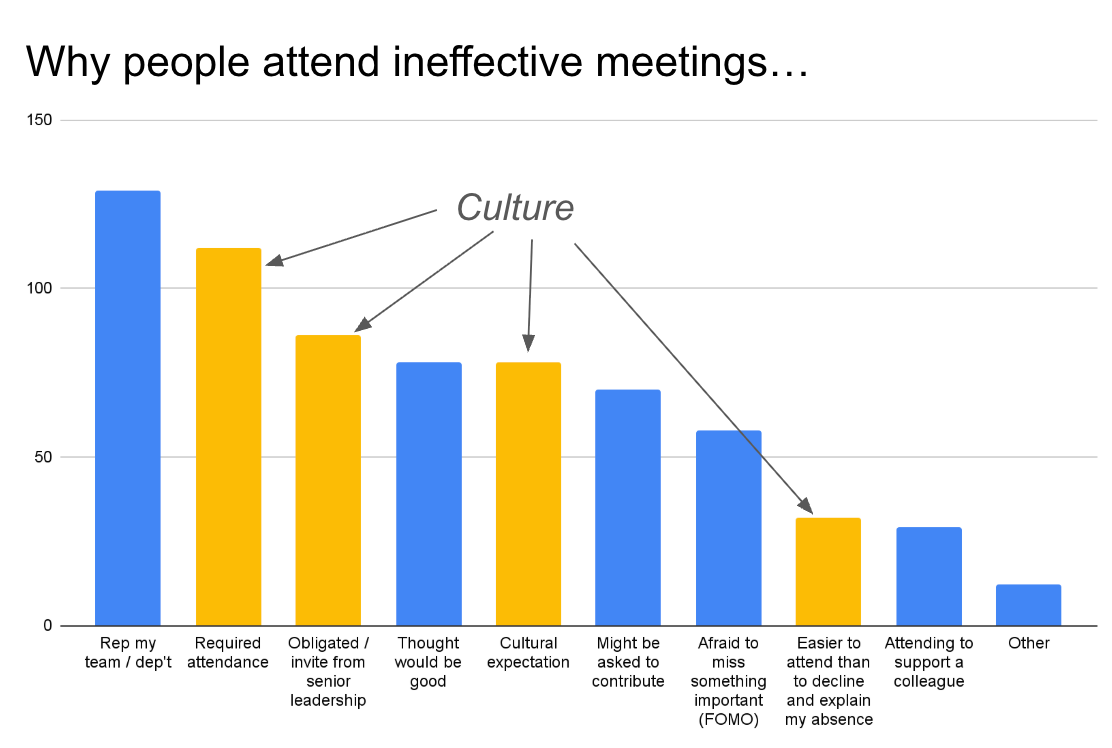
Recent research by Work Forward and Dropbox found that 48% of meetings are ineffective and a bad use of time. Often, you know it in advance. So why show up? It’s your company’s culture: being visible mattering more than impact, required attendance, and an inability to say “no.”
Source: Reimagining Meetings, November 2025
Work Forward is a newsletter dedicated to making work better for people. Like what you’re reading? Please like ❤️, subscribe 📨, and share 🔄
AI is amplifying the dysfunction
Enter AI, which should help solve the meeting problem but is instead making it worse in predictable ways.
“AI is making this reflex even easier because people start to assume that AI is going to capture the discussion, the details, the decisions,” Hinds says. “They start to tune out, they start to multitask, or they stop showing up entirely.”
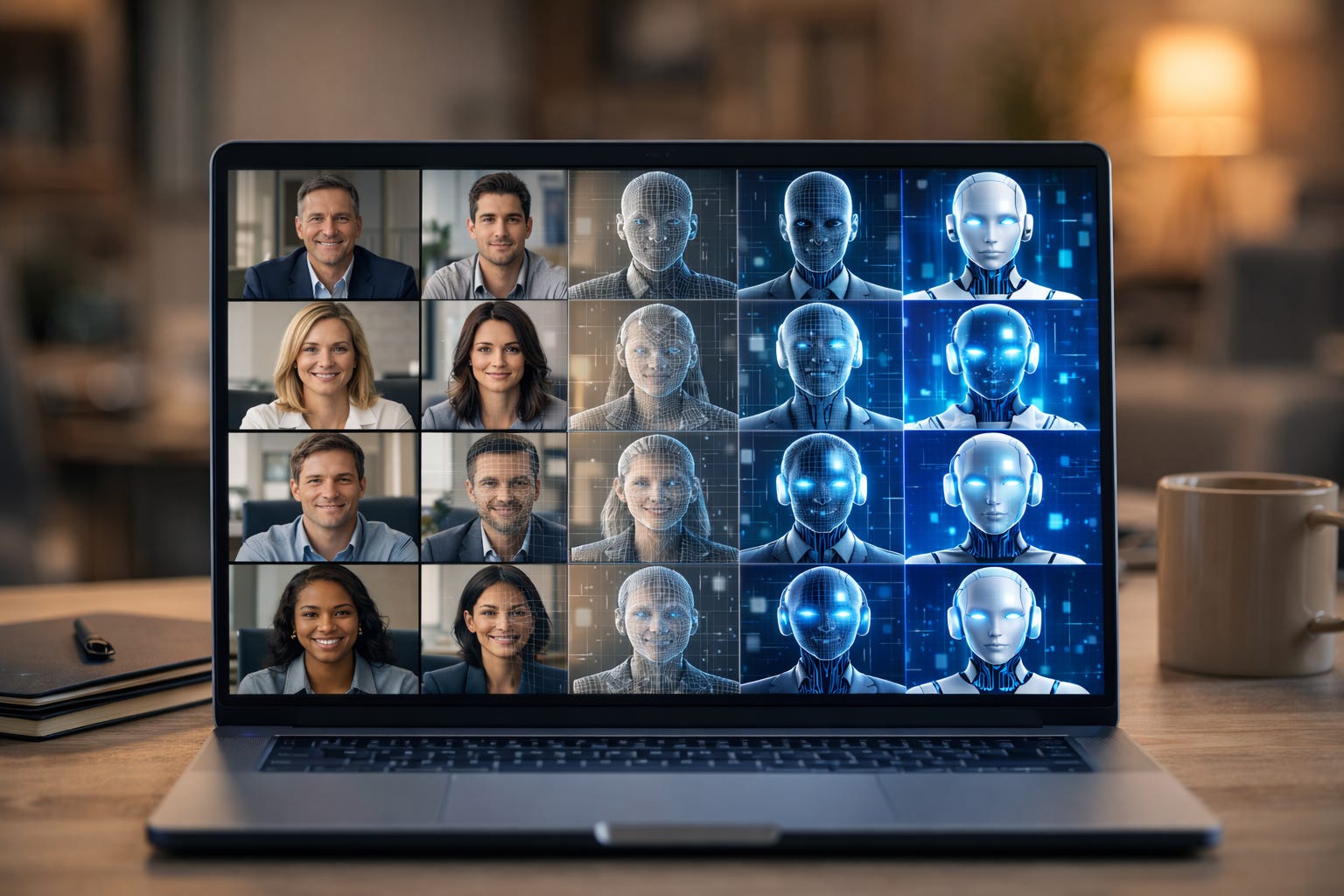
That last part deserves emphasis. People sending their AI bots to meetings instead of attending themselves isn’t a clever productivity hack, it erodes what researchers call “mental proof.” As Hinds explains it,
“There’s nothing that says your time matters more than the other people in the room than sending your bot instead of showing up yourself.”
Think about what that signals: You’ve prepared for this meeting, designed the agenda, shown up as a real human—and half your attendees sent bots. The message is clear: your meeting wasn’t worth their time. But rather than cancel the meeting, everyone’s now optimizing around its existence.
“I think there’s a broader pattern with AI where we optimize what we’re already doing instead of rethinking it,” one Forum participant noted.
That’s the trap. We’re using AI to make dysfunctional meetings slightly more tolerable rather than asking whether the meeting should exist at all.
The double-edged sword
But dismissing AI entirely is an even worse idea. At a minimum, AI’s ability to summarize meetings, decisions and next steps is a huge boon to day-to-day effectiveness of teams.
Even more promising: Hinds has seen in prior research that when you give people better visibility into how they’re collaborating, many will self-correct in surprisingly healthy ways. The same could be true in meetings, especially with data on airtime. That matters because more balanced participation is one of the strongest predictors of high-performing teams.
The other key factor: implied intent and trust determine whether these tools help or hurt. If employees think the data will be used to evaluate them (or worse, to punish them), AI can backfire fast. Technology doesn’t determine the outcome. Your culture does.
As Hinds puts it: “AI amplifies whatever exists in your organization. It amplifies the dysfunction. It amplifies the goodness.”
Treat meetings like a product
So what actually works? Hinds’s core insight: treat meetings like a product. Employees are customers; work flows through tools, documents and meetings.
“Meetings are the most important product in our entire organization. They’re where decisions get made, alignment gets set, culture gets built or broken, and yet they’re the least optimized.”
Organizations scrutinize every budget dollar but “close their eyes, cross their fingers, and surrender to bad meetings.” The solution is applying product design principles—design, feedback, iteration—to meetings.
Start with a “Meeting Doomsday.” When Hinds launched the Work Innovation Lab at Asana, meeting debt had spiraled out of control. So they tried something radical: employees deleted all recurring meetings for 48 hours, then chose what to add back. Meeting Doomsday and a rapid post-apocalyptic recovery.
In the first Doomsday she led with a small team, employees saved an average of 11 hours per month. But the real value wasn’t the time savings, it was who controlled the redesign.
“That activated what’s sometimes called the IKEA effect,” Hinds explains. “When we build something ourselves, we not only value it more, but we’re more likely to stick to it.”
Unlike top-down calendar purges that backfire within weeks, employee-driven redesigns last because people own the choices.
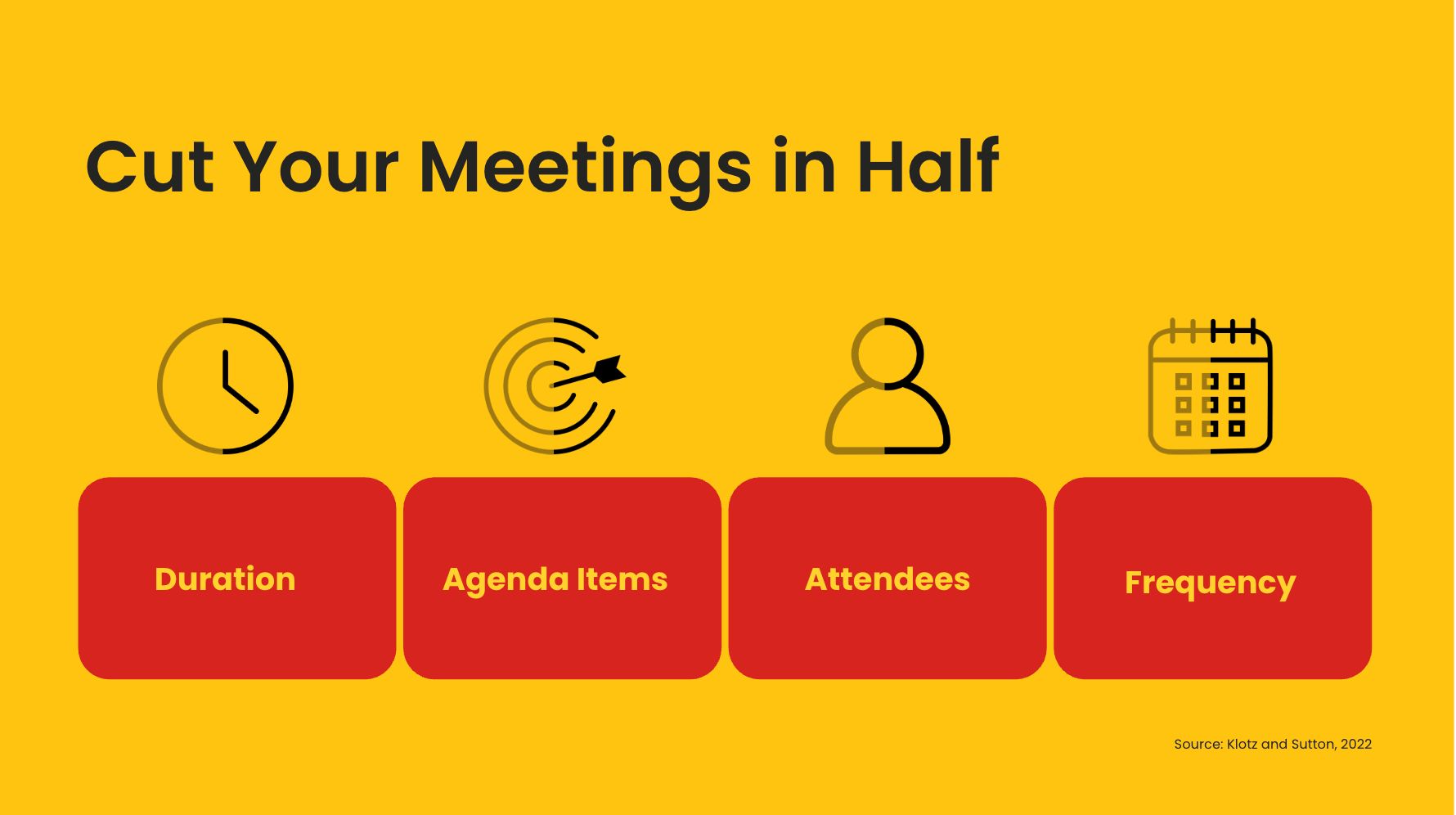
Become a Meeting Minimalist. Hinds recommends what Stanford professor emeritus Bob Sutton and University of Virginal Professor Leidy Klotz call the “Rule of Halves.” Applied to meetings, this means taking a dysfunctional meeting and cutting one or more dimensions in half. Duration, agenda items, attendees, or frequency.
Source: Your Best Meeting Ever
Could that 30-minute meeting be 15 minutes? Could that 200-person update become 15 people with status updates sent to the rest? Can we use non-standard durations (like 27 minutes instead of 30) to jolt people out of autopilot?
Parkinson’s Law tells us that work expands to fill the time allotted. If you give a meeting 30 minutes, it will take 30 minutes whether it needs to or not. Better still, in my experience, start meetings at 5 minutes after the hour. It’s more realistic you’ll get 5 minutes to breathe, stretch and hit the bathroom than if you try to end five minutes before the hour. (p.s. that standing and stretching session might save your life).
🔆 Special Offer 🔆
Want to hear Rebecca Hinds live? Join Charter’s Leading with AI Summit on Feb 10th in NYC to hear from Rebecca, along with Nickle LaMoreaux (IBM), Sebastian Siemiatkowski (Klarna), Katy George (Microsoft), Ronnie Chatterji (OpenAI), Iavor Bojinov (HBS), Gabriella Rosen Kellerman, MD (BCG), Brandon Gell (Every), Melanie Rosenwasser (Dropbox), Mary Alice Vuicic (Thomson Reuters) and more!
p.s. SF on Feb 24th is just as good.
50% off in-person registration (pending approval) with the code FORUM!
Anyone can register—for free—for the virtual sessions.
The one-on-one question
What about one-on-ones? With leaders like Jensen Huang publicly saying he doesn’t do them with his direct reports, some executives are questioning whether they’re necessary.
Hinds is unequivocal:
“One-on-ones between the direct manager and the report matter immensely. There’s nothing you can be doing that’s more important as a manager, as a leader, than having that constant check-in with the direct report.”
Here’s a critical note: she’s talking about manager-to-direct-report relationships. Beyond that core relationship, one-on-ones often create dysfunction.
Organizations create duplicative meeting chains where the same information flows through multiple one-on-ones with peers, skip-levels, and cross-functional partners. “In general, I think we can streamline and make more efficient the one-on-ones that happen beyond that relationship.”
As for the Jensen Huang example? “You aren’t Jensen Huang, and your reports aren’t SVPs,” as one Forum participant put it. Your company isn’t NVIDIA, and individual contributors reporting to line managers need different support than executives running billion-dollar divisions.
The efficiency versus connection tension
One challenge that surfaced repeatedly: the tension between efficiency and connection.
“People take meeting time personally,” one participant noted. “Folks are lonely, our folks are clear, they want to come back together more. Where is there space for connection building, especially when folks are working very digitally?”
Hinds acknowledges this but challenges the premise that meetings are the best mechanism for building connection.
“The reason we want to make our meetings more efficient is to free up time for the things in work and life that shouldn’t be highly efficient. And developing connection with other people is at the top of that list.”
If the primary purpose of a meeting is establishing connection, consider alternatives. Research shows that “multiplex relationships”—connections built through shared meals or activities based on common interests—create stronger bonds than scheduled meetings.
The goal isn’t ruthless efficiency for its own sake. It’s freeing up time for connection that actually works.
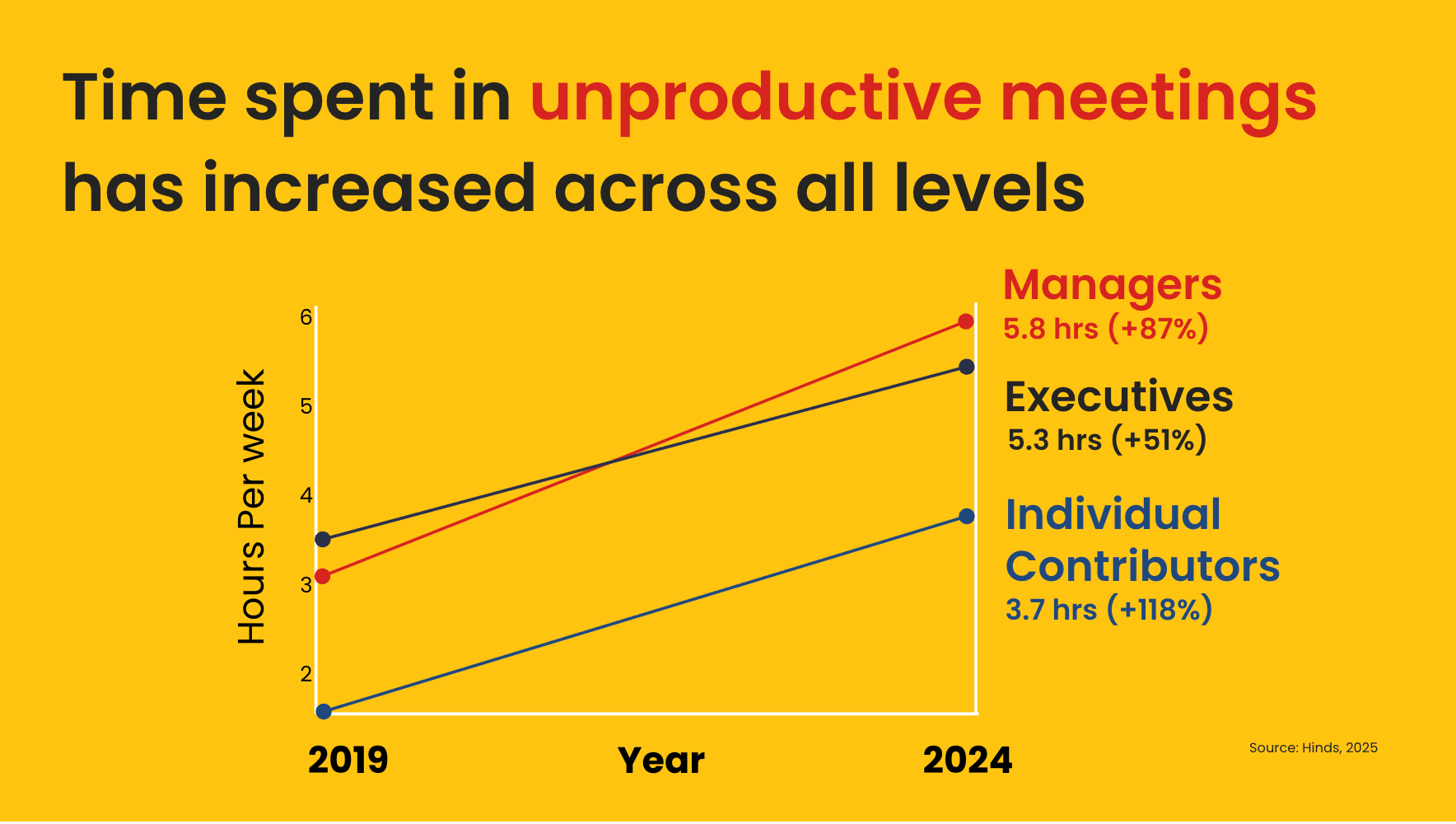
We need to also think about which audience you’re solving for. Making your weekly team meeting into a connection-free efficiency forum can trash one of the few opportunities individual contributors can connect. But your managers are the ones most at risk for meeting-driven burnout.
Source: Your Best Meeting Ever
The systems-level fix
Here’s the uncomfortable truth: no amount of memos will solve bot overuse or meeting dysfunction.
The real solution requires giving employees explicit clarity about what deserves to be a meeting, what outcomes they’re responsible for, and what their relationship with AI should be.
“If our meetings are broken, it’s usually a symptom of a bigger problem,” Hinds says. When employees don’t understand which tool to use for what purpose (meeting versus Slack versus Asana versus email) they default to meetings because meetings reliably get people’s attention.
The fix isn’t technological. It’s cultural. Organizations need to answer: What deserves to be a meeting in our organization?
Ask four different people and you’ll likely get four different answers. That ambiguity is expensive.
What to do Monday
Start simple. No one reads 15-page meeting improvement playbooks. Instead:
Define what deserves to be a meeting. Create simple principles like the “3 D’s”: Debates, Decisions, and Development. Make it permissible to decline meetings that don’t serve a clear purpose.
Give one team Meeting Doomsday. Pick a pilot team, wipe their recurring meetings for 48 hours, and let them rebuild intentionally. Measure the impact.
Set clear AI norms. If people can send bots, when is it acceptable? What’s the role of transcription? Frame AI as an enabler, not surveillance.
Protect manager-direct report 1:1s. These are sacrosanct. Let the direct report drive the agenda. Everything else is negotiable.
The organizations that figure this out won’t just save money. They’ll free their people to do work that actually matters. Because the problem was never about where people work or whether they use AI.
It’s about whether leaders have the courage to admit that half their meetings shouldn’t exist—and to do something about it.
Want more? I can’t recommend highly enough the rich content and incredible collection of research and practical guidance in Your Best Meeting Ever!
What’s your best meeting improvement move?
Closing thoughts
"People don’t want to leave their homes. Schools are online. Kids activities cancelled. However, neighbors and friends are really stepping up. We deliver groceries, transport their kids, etc. It is beautiful to see people help others. The circumstances are unbelievable."
That was from a friend in Minnesota, sent the week before Alex Pretti was killed. It’s both horrifying and hopeful: stories of brutality, and a community coming together to support one another and speaking up for what’s right and fair.
People can’t help but be impacted by the chaos around them and bring some of that to work. But work can be a respite. Leaders need to recognize the stress, and provide support or at minimum acknowledgement.
As I wrote over the weekend, the answers internally don't start with leaders suddenly finding their voices. They start with giving managers the time, tools and bandwidth to support their teams. I shared a few ideas in recent Charter column (and in TIME).
At a minimum, we all need to keep in mind that that many, if not most, people are grappling with compounding stress. Support one another where you can, give each other a bit of grace, and extend that grace to yourself as well.
Superb take on treating meetings like a product. The Meeting Doomsday concept is genius because it flips the default from "justify why we shouldnt have this" to "justify why we need it." Reminds me of zero-based budgeting but for time, and honestly I've seen way more resistance to timeaudits than spending audits in organizations.
Some interesting ideas here, some of which I am going to trial. Thanks for sharing with us.