
Gratitude and generosity
We're living through the 'greed is good' sequel nobody asked for. Here's how gratitude and generosity can write a better ending.

“Tell the people you love that you love them. Tell them why. Do it over and over.”
Anna Binder said that in a Charter session on culture as a competitive advantage this fall, and it’s been stuck in my head like a song I can’t shake—except instead of annoying me, it keeps reminding me of a change I’m trying to make.
It hit me hard because it’s a lesson I keep forgetting. I get busy, my ADHD kicks in and my focus tunnels down to whatever’s immediately in front of me—and suddenly I’ve forgotten about the people around me. The folks I love, respect, and need. The people who make life fulfilling.
I’ve also had a few not-so-subtle reminders recently that life is short and nobody gets a do-over. On their deathbed, nobody looks back and thinks “damn, I really should have gotten that promotion.” (Well, maybe a few well-known narcissists would, but they’re not reading this newsletter.)
I’m a big fan of Clay Christensen’s “How will you measure your life“ talk, which boils down to: the impact we have on people around us is what actually matters. Or as the Greek proverb puts it: “Society grows great when old men plant trees in whose shade they know they shall never sit.”

It’s Thanksgiving week in the US—a time when we’re supposed to express gratitude and thanks to the people we love and those who’ve supported us. Which is almost hilariously ironic given the pendulum swing in American culture right now.
We’ve gone full-bore back to individual gains over collective good, returning to the “greed is good“ ethos that defined the start of my career in the late 80s. (Yeah, I’m that old. Get off my lawn.)
A friend recently pointed out that Thanksgiving has evolved from “knock off Wednesday afternoon, back Monday morning” to “pretty much a dead week where nobody’s pretending to work” followed by massive Sunday Scaries. We’re all so burned out by this godforsaken year—the stress, the anger, the damage—that we need every minute of that break.
In early December, I’ll climb back on my research-driven, case-study-supported wagon and build the case for a better path forward in 2026.
This week? Let’s talk about something more important: gratitude and generosity.
Gratitude
Here’s your reality check: Recent research says only 20% of office workers have a healthy relationship with work, down from 28% last year. Their bosses aren’t exactly thriving either—only 34% of managers report healthy work relationships, down from 51% the year before.
The litany of workplace woes is long, but it comes down to one brutal truth: we’ve decided short-term results matter more than the humans delivering them.
We’ve traded wellbeing for quarterly earnings, humanity for efficiency metrics, and then act surprised—shocked!—when engagement tanks. We’re grinding people beyond the 996 (9am to 9pm, six days a week), fueled by Peptide Fridays (I wish I were kidding), and somehow can’t figure out why enthusiasm’s at a new low.
Want to actually turn this around? Start with something radically simple: gratitude.
Recognition—making people feel seen, valued, and celebrated for their accomplishments—beats out goal clarity, balance, purpose, technology, and ability to focus. It’s not even close.
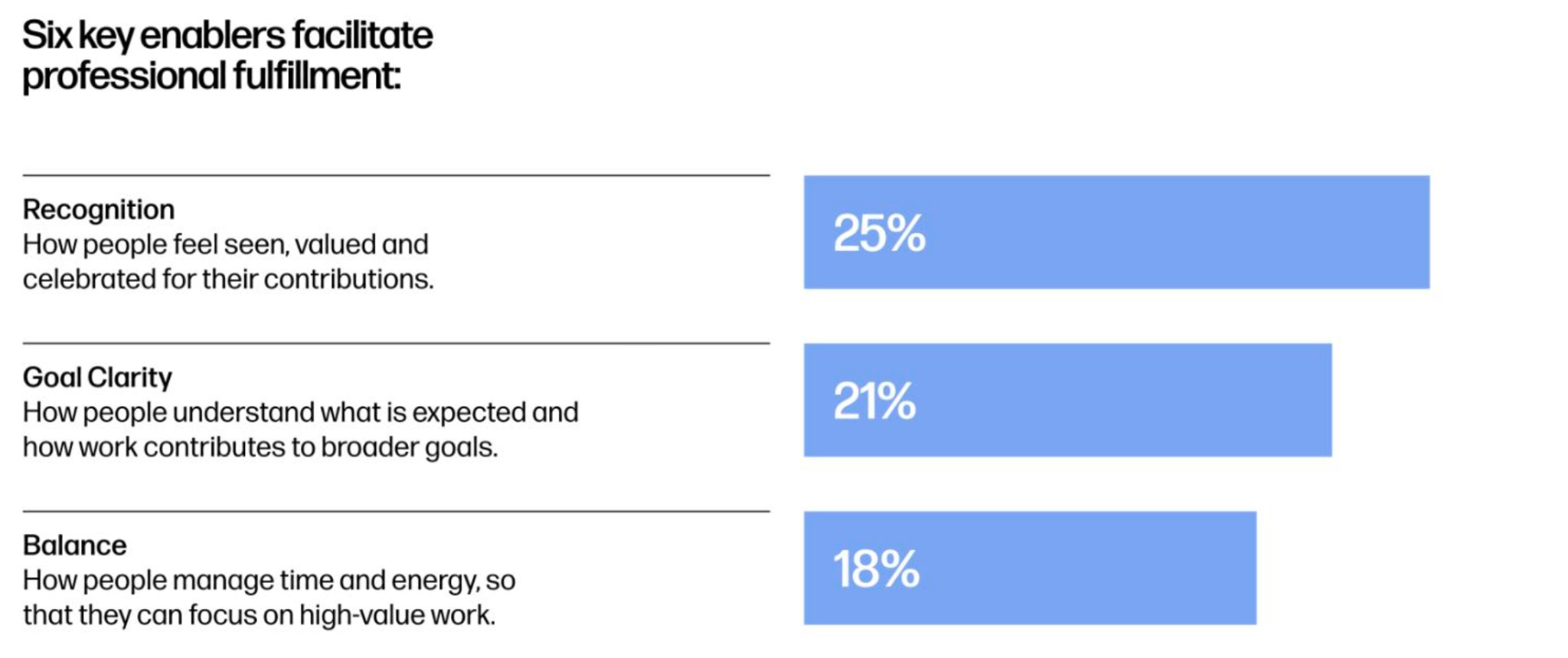
Source: HP’s Work Relationship Index 2025
Expressing gratitude at work isn’t just about celebrating the team that crushes their goals (though please, for the love of god, do that). As my friends at Charter noted, positive feedback is wildly more effective at creating positive change than nagging. Want better meetings? The boss using scheduled send instead of sending midnight missives? Say thank you when people do it right instead of complaining when they don’t.
Gratitude can be as simple as the note you keep meaning to send. Back when we were building Future Forum, the whole team got more energy from hearing “I shared your research with my boss and it actually worked” than from any metric about reach or executive engagement. Simple expressions like “thank you, what you worked on matters” go phenomenally far.
Want to level up? Send a letter to the parents of people who work for you, telling them how wonderful their kid is and how much you appreciate them. Indra Nooyi did this as CEO at PepsiCo, and it wasn’t just heartwarming—it worked.
Gratitude, like all good feedback, works best when it’s timely, specific, and tied to impact. The employee who solved a customer’s problem even though it wasn’t their job? The person who finally fixed that terrible meeting? The peer who distilled that dense report into something actually readable? Thank them. This week. Today, even.

My 2026 resolution? Stop saving gratitude for Thanksgiving. Tell someone what you appreciated this week. Or better yet, tell them what you appreciated today.
Because gratitude recognizes what people have already done. But generosity? That’s about what you’re willing to give without expecting anything back. And right now, we desperately need more of both.
Generosity
Last week, Lenny Rachitsky‘s podcast dropped a wonderfully long interview with Slack co-founder Stewart Butterfield. For those of us who worked at Slack for years, it was a reminder of Stewart’s thoughtful-and-thorough approach to building a genuinely customer-centric business. “In the long run, the measure of our success will be the value we create for customers” wasn’t just a saying he made us repeat like a mantra one time—we all knew it and knew he meant it.
Stewart was tough. He challenged people, set audacious goals, and could be stubborn as hell. But critically, he balanced all that expertise and experience with humility and generosity. Stewart’s MIT Technology Review interview got clipped and posted around the office. Not exactly the P.T. Barnum style of most enterprise software:
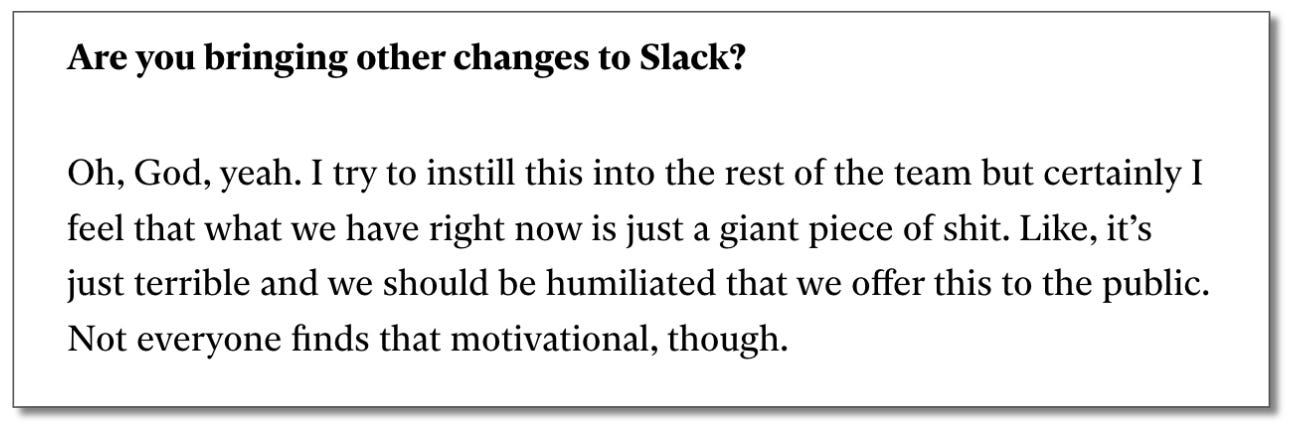
Stewart’s combination was rare. As Anna Binder noted in that same Charter conversation up top, “Finding executives and Board members with expertise and humility can be challenging.” Understatement of the century.
The real kicker in Lenny’s interview comes at the end, when he tells Stewart that the one theme that kept coming up from former Slack employees was his generosity. How he personally helped people find new roles when they had to do layoffs at the company that became Slack. The small, individual gestures that were meaningful to people in ways Stewart probably never realized.
I did a lot of “walk and talks” with Stewart over the years—none more memorable than the socially distanced, AirPods-in version during spring 2020 when I switched jobs. I was walking away from a bigger, more traditionally rewarding role leading our Developer Platform to take a flyer on building a think tank. From guiding a sizable org to betting on three of us getting something off the ground. His support mattered more than I suspect he knew.
Lenny’s interview brought back good memories for a bunch of us who worked there. It felt especially refreshing in 2025, when our feeds are dominated by modern tough-guy leaders doing their best Ebenezer Scrooge impressions.
Fear burns out, generosity persists
Here’s what Scrooge and those playing up layoff fears are missing: generosity at work isn’t charity. It’s strategic.
Leaders who demonstrate generosity—taking a smaller share of rewards upfront, reducing their cut after poor performance—see significantly higher engagement and better outcomes. And here’s the part that should make every male executive uncomfortable: women leaders are significantly more likely to show this kind of generosity, even though both genders take responsibility equally. Men, pay attention.
Generosity at work doesn’t have to be some grand top-down gesture. It’s extending a hand to an overextended teammate. Volunteering to clean up after the all-day offsite when everyone’s exhausted. Sharing credit when you could hoard it.
For me, it’s also about creating connections—linking people where there’s mutual benefit, new opportunities, or just where the vibe feels right. I’ve been tracking these introductions for the past couple of years, averaging a couple hundred every six months. It costs me nothing but a few minutes and a thoughtful email, but occasionally it changes someone’s career trajectory or just connects two people to build from a vibe to a movement.
Outside the workplace, our world could use a whole lot more generosity. Random acts of kindness are in order:
Tip too well. That extra $2 on your $5 latte won’t break you, but for someone working multiple shifts to afford rent in this economy, it matters. A lot.
Let it slide. The guy who cut you off in traffic? Maybe he’s a jerk. Maybe he’s rushing to the hospital. You’ll never know—and getting angry won’t improve either scenario.
Text someone who needs it. Right now, before you move on to the next thing. “Thinking of you, how’s it going?” takes 10 seconds and might land exactly when they need to hear from someone.
Say thanks. Right now. Before you close this email, text one person who helped you this week. Tell them why it mattered. Go ahead—I’ll still be here when you get back.
I’ll also note: this is very much a “doctor, heal thyself” column. I do about half of this, but then I get busy—or some jerk cuts me off.
Last, if you’re looking for somewhere to give this Thanksgiving: your local food bank. Yes, it’s absurd that in a country with 902 billionaires (double what we had a decade ago), people are going hungry. But here we are, and they desperately need help.
Here are some recommendations: find your local food bank, or if you’re in the SF Bay Area, check out SF Marin Food Bank, Second Harvest Silicon Valley, or my favorite, 18 Reasons.
For all my US readers, I hope you have a wonderful Thanksgiving week. Tell the people you love that you love them. Tell them why.
And then do it again next week.
Credits: Thank you Maureen. I love you more every day.
Related reading
Eight ways leaders can show gratitude at work by Michelle Peng at Charter is a great round-up of methods for sharing thanks with teams at work.
Building Slack by Ali Rayl and Johnny Rodgers has great storytelling and lessons from the Glitch pivot forward.
Not related, but not to be missed
AI may be gaslighting you. BCG consultants fact-check, AI pushes back. If I wanted that, I’d hang out on Twitter/X.
Do not follow the HR practices at SHRM, the “world’s largest HR organization,” unless you want a dispirited workplace and potentially lawsuits.
Brian, this is a fantastic newsletter. Thank you for the insight and reminders of what is important. Much appreciated!! Happy Thanksgiving to you and your family! And, thank you for your continuing to send us your regular newsletter. I read it all the time.