


Here’s a list of the top challenges for leaders: Technology pace is moving too fast for the workforce to adapt. We can’t find enough people with the right skills. No budget left for learning and development. Young people don’t want to work hard. Lots of technically skilled managers, but few who can motivate a team.
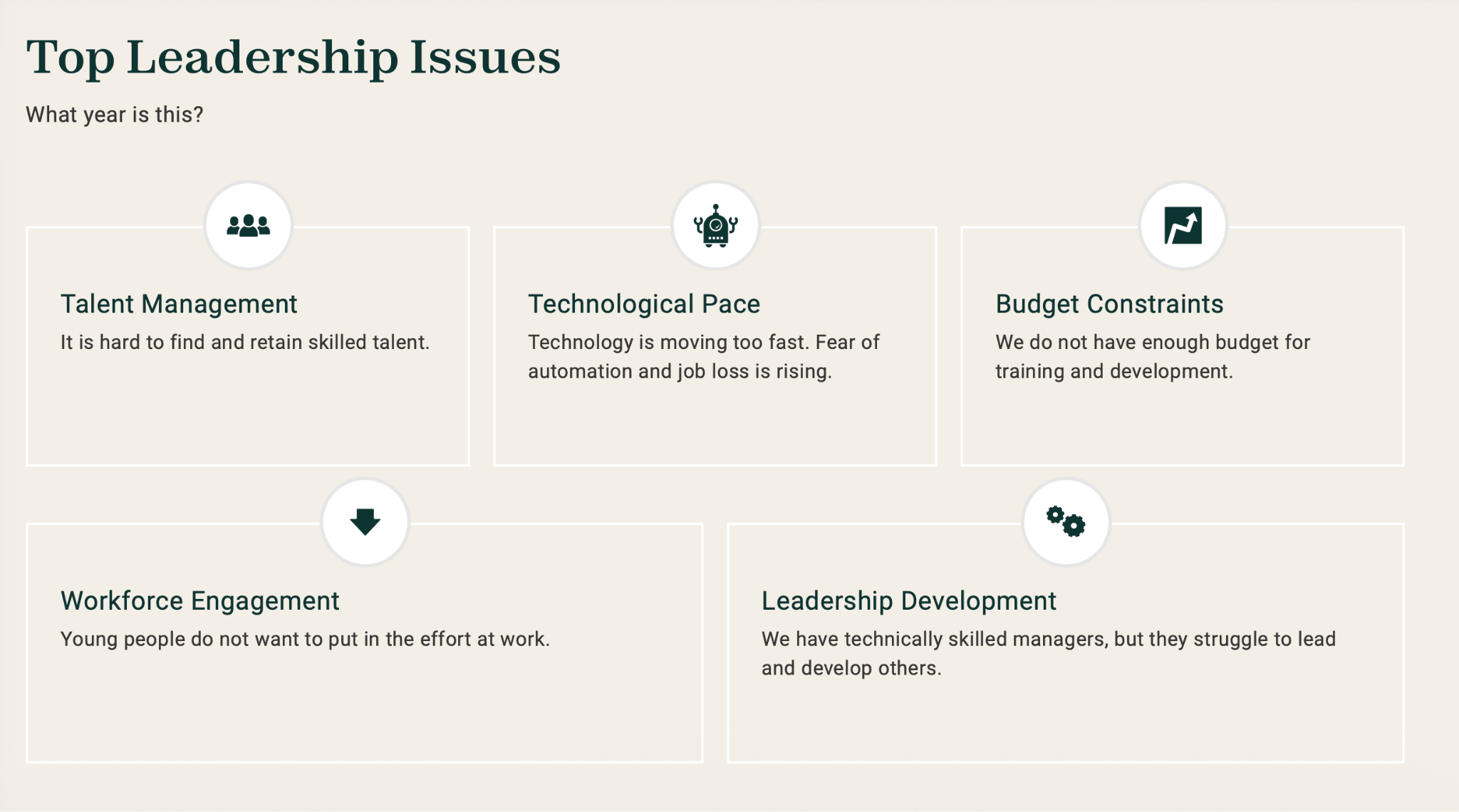
Source: Dr Kelly Monahan, Reclaim the Plot
Dr. Kelly Monahan presented that list to a Charter Forum session last month and then asked us to guess what year that list was compiled. The group responded: 2018, 1997, 2015, 2011, 1985. One CPO said what everyone was circling around. “It could have been 1995. It could have been 1955. You tell me.”
It was the 1950s. At an industry association meeting held while the first robots were being deployed into manufacturing. It’s a list of issues older than the interstate highway system. It has outlasted eleven presidents, the entire lifespan of the fax machine, and about forty years of consultants promising fixes.
Kelly’s take: “AI is becoming a very expensive way to realize how poorly designed our workplaces were in the first place.”

Dr. Kelly Monahan
We’re running 2026 output on ‘70s architecture
The org chart is a remnant of Taylorism-era industrial management, not a law of business. The ‘70s architecture is more 1870s than 1970s.
Most reward systems still pay you for the number of humans you manage rather than the outcomes you generate, which is why every reorg turns into a headcount negotiation. Most cultures still run on visible effort, which made sense when work was physical and you could watch it from a catwalk.
None of this was working especially well before. It was survivable, and mostly invisible. The same way a cracked foundation is invisible until you try to remodel.
The pressure is real, and personal, for leaders. Half of CEOs believe their own job security depends on getting the AI strategy right, based on BCG’s AI Radar. Over 90% say they’ll maintain or increase AI spending even if it returns nothing over the next year. Some of that is rational: experimentation, and iterating on solutions.
The pressure comes from every direction. Even a CEO who knows this takes longer than the headlines suggest still has a board, investors, and a LinkedIn feed telling them they’re behind.
A designer I spoke with recently, 15 years into her career and working at a mid-size tech company, was told every project she touched had to involve AI even if it took longer to build a result to their quality standard. Her performance was marked down for not being visible enough in supporting AI. Her company was chasing a funding round, and the partnership with a major AI lab mattered more than the reality of its benefits. The mandate’s target audience wasn’t their customers.
Transformation is not for the timid
AI genuinely does change what work needs doing. But the changes that reset competition in an industry won’t come from replacing 20% of a function with agents. They’ll come from more fundamental, cross-functional redesign of how value gets created.
Refusing to touch the org because change is uncomfortable is a lack of leadership. What organizations might actually look like, it turns out, might be more like the visual from the first known “organization chart”: Daniel McCallum’s organic-looking railroad company from (gulp) 1855:
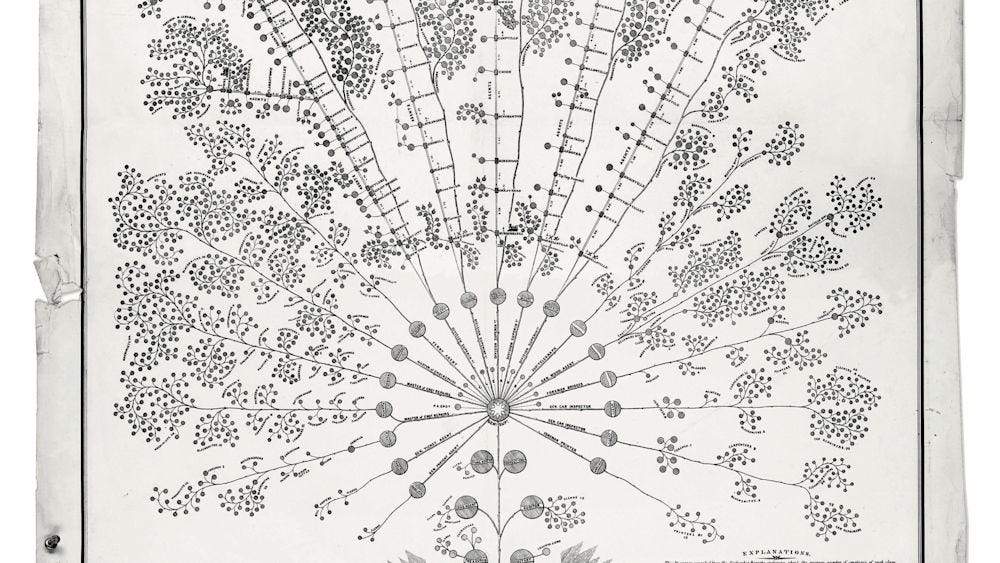
Source: The Org, by Sarah Hallam
Redesign means changing the handoffs between functions, shutting off workstreams and administrative burdens whose origins are lost. Taking real risks in moving away from centralized decision making. That last bit is hard. Passing decision-making authority down organizations where the culture is rooted in decades of risk avoidance. Telling execs to let go.
Instead, most AI transformation to date is mostly just cutting: leave the function as-is, reduce by 20% and the survivors have to adopt AI to deliver against the old output goals. No changes to the machine itself, just a different fuel mix.
Power, and why founder mode is the wrong lesson
The title of Kelly’s upcoming book, Reclaim the Plot, gives a hint about her framework. The real operating system of an organization runs on four things: power, listening, ownership, and trust. Who has agency and where decision rights sit. Which signals actually reach the top. Who owns the outcome. And whether any of it, the data included, can be depended upon.
Source: Reclaim the Plot by Kelly Monahan
Let’s talk power, and then trust.
Power right now is flowing up, not down. The tough-talking leader is in control, ruthless CEOs running their companies on efficiency and maximizing performance. So are the founders who read Paul Graham’s founder mode as permission to micromanage everything, slowing the whole organization down to their own clockspeed.
In a startup of 10 people, you can have a hive mind; as you scale to 30, founder mode is leadership. At thirty thousand, it’s cosplay. Kelly credits the focus on the changing nature of power to General Stanley McChrystal, who found in Afghanistan that the intelligence sat at the edge with his teams. Routing every call back to the Pentagon was getting people killed. Pushing decision making down to where the information sits is at the heart of Team of Teams, one of the best management books ever.
Brian Chesky centralized product planning during COVID. Airbnb was fighting for its life, and it worked. Graham turned that into a manifesto in 2024. The stock market doesn’t seem to be as much of a fan.
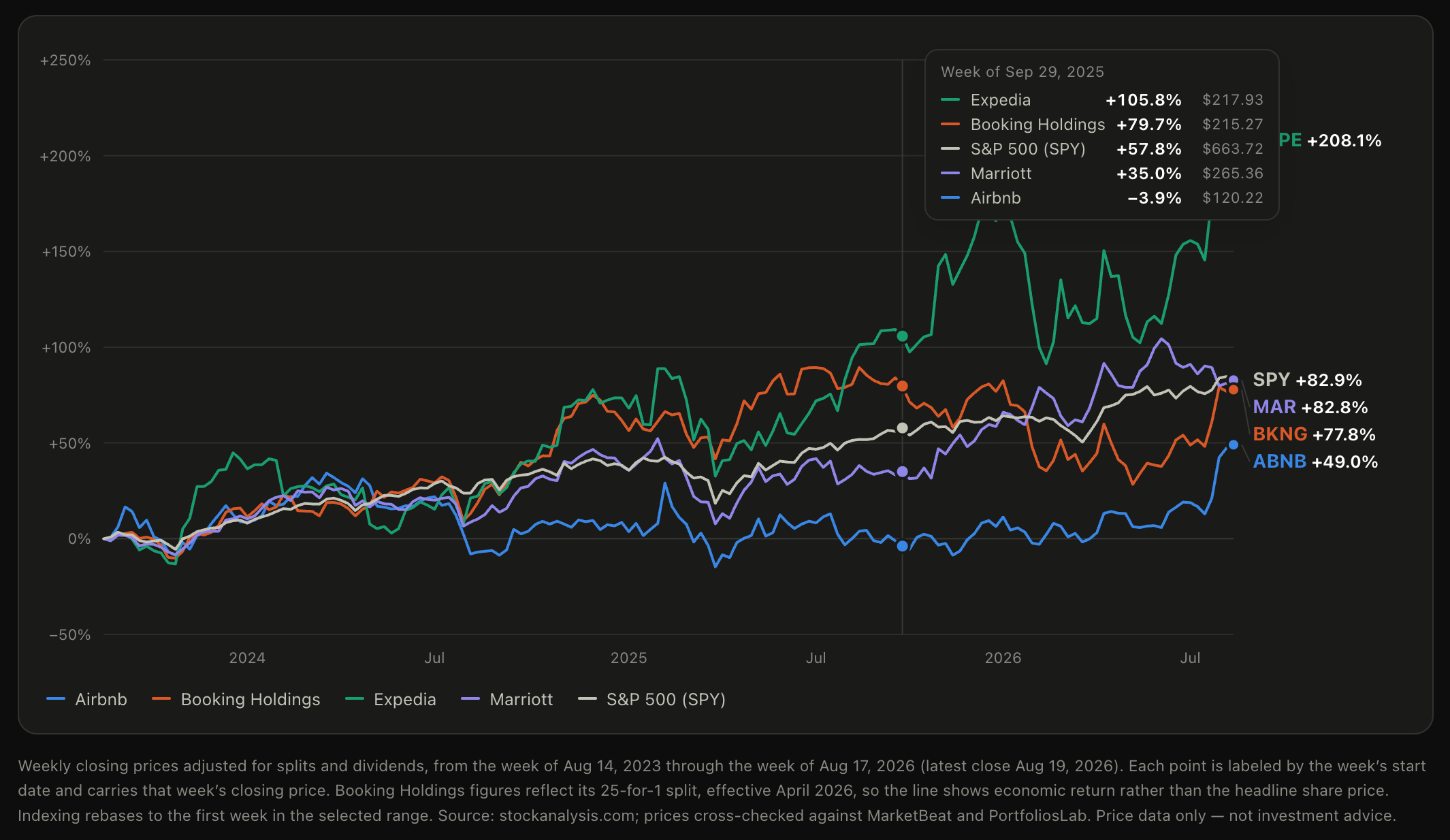
Source: Three year comparison of Airbnb, Booking, Expedia and Marriott
Kelly’s larger argument is that leaders never shed the pandemic fever, and founder mode is an emergency measure that outlived its emergency and got rebranded as a philosophy. She spends a whole scene of the book on it, filed under “The Refounding Illusion.”
I lived the first act of Kelly’s counter-example of how you push power to the edge. During the dot-com bust, I was leading an ecommerce marketplace, supplying Amazon, Borders, and Chapters up in Canada, and the consensus was that e-books would eat everything and moving physical books was a business dead on arrival. Borders went belly-up.
Barnes & Noble was supposed to be dead stores walking. But James Daunt pushed power out of HQ and gave book buying decisions back to store managers: what to stock, how to shelve it, and what goes on the front table. That was a real bet: the publisher co-op money that had been deciding what got shelf presence went poof, on the theory that local decisions would beat it. It worked. The center got smaller, and they opened 50 stores last year, back near their all-time high.
Trust, and the number underneath the number
All this efficiency ought to be producing companies people believe in. Employees increasingly don’t. Confidence in their own employer hit a record low in July. To give credit, senior-level confidence went up 3.1 points month over month but line managers along with individuals continued to fall. Executives are far more likely to think employees are enthusiastic about AI, for example, than they really are:
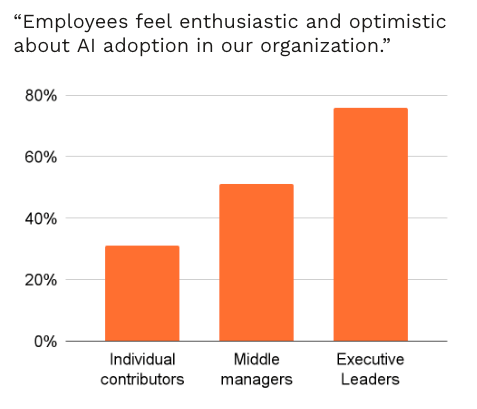
Source: BCG Institute and Columbia Business School, Oct 2025
Delirium is the word Kelly used for that gap: leaders believing one story while their workforce is living a different one.
Early-career workers have a right to be pessimistic. Stanford’s Digital Economy Lab finds employment for 22-to-25-year-olds in AI-exposed occupations runs about 19% below the comparison with peers in less-exposed jobs, up from 15% a year ago. The good news? There’s not the same pattern among experienced workers (yay, us?). At least for now.
Kelly’s prescription is pretty basic: be open, point to potential, and give people agency while being clear that nothing is promised.
“What people are desperate for right now is a sense of steadiness. No matter what’s coming at us, this is who I am, this is how I show up every day, and this is the value we’re going to create together.”
Three things to do this quarter
Push one class of decision down, and say so. Blow up that five-layer decision sign-off chart in marketing. Make clear what scope of decisions a product team can take on its own. The gap between intelligence and authority closes when somebody up the chain gives up power. Start at the top, not the middle.
Say what you’re holding constant. I asked a dozen senior leaders whether they’d seen or produced a list of what isn’t changing this year. No hands went up. If all the talk is change, balance the scales by saying what remains the same and what’s off the table—at least for now.
Change what you reward. We undermine risk taking every day, and refuse to invest in the real cost of change. Only 13% of AI users feel rewarded for reinventing work if there’s a short term hit and 45% say it’s safer to just focus on hitting today’s number. Redesign comes at a cost, and won’t happen if it runs contrary to not only compensation but fears of being laid off.
The list Kelly presented has been with us for seven decades. AI just makes the cracks in the seams more massive and visible than ever.
Where’s the authority sitting in your organization right now, and when’s the last time somebody moved it? I’d love to hear what’s working, and what isn’t. Drop a comment or write to me directly.
Do me a favor
If something here resonated with you, or and you know a leader grappling with what AI transformation really takes, please forward this email or share it!
Meet up in NYC?
I’d love to have you join me at the Charter Workplace Summit in NYC on October 21st! I’m helping organize this year’s event, along with co-chairs Betty Larson (CHRO at Merck) and Amy Reichanadter (CPO at Databricks).
The lineup is already pretty stellar, and we’re not done announcing. Speakers and panelists like Annie Duke, Harvard’s David Deming, Brigid Schulte on caregiving, CNN’s Van Jones, bestselling authors Manoush Zomorodi & DJ DiDonna, CPOs like PWC’s Yolanda Seals-Coffield & Patagonia’s Theresita Richard and many more will help us navigate the future of work.
I’m also very excited about a research project we’ll be unveiling. I can’t share details yet, but it’s something I’ve wanted to do for three years!
Join us, in person or sign up for the free virtual session!
Editor’s notes
I liked Reclaim the Plot enough to write a blurb for the book, coming out Sep 29th:
“Makes a compelling case for why organizations need to stop performing outdated models of work and start building ones that are more honest, adaptive, and human.”
It’s also darn good storytelling.
Disclosure: I’m a senior advisor with BCG, but I’m not compensated for citing their research. I just think they do good work.
"Delirium vs. Organizational Crazy-Making: Moving Beyond Taylorism."
Brian and Kelly, this is a vital diagnostic pivot. The rigid org chart is merely a historical remnant of Taylorism-era management, not an immutable law of business. At best, that chart represents only one-tenth of the true enterprise social order. The other 90% is governed entirely by the informal behavior system.
Kelly uses the word 'delirium' to describe the gap where leaders believe one formal story while their workforce lives a completely different informal reality. In my fieldwork, we call this 'organizational crazy-making'—a state of chronic, systemic cognitive dissonance.
The current enterprise push for agentic AI is shedding a harsh light on these exact misalignments between our dual macro culture-shaping forces. True transformation requires moving past surface-level traits to directly target and realign the hidden disconnects within the live social network.
This isn't work for the faint of heart; it requires serious systems-science practitioners. Traditional OC theory remains trapped in a pre-paradigmatic stage, wholly unable to match the exponential complexity dynamics implied by AI.
This is a must! "Taking real risks in moving away from centralized decision making. Passing decision-making authority down organizations where the culture is rooted in decades of risk avoidance. Telling execs to let go."